Lobster Tank
How do we build a system for generating, curating, validating, and prototyping ideas? That's the question this document tries to answer.
TL;DR
The cost of shipping software is collapsing. As a result, bottleneck has moved upstream: knowing what to ship, for whom, and why now. There are a lot of words on this page—as Mark Twain once said, "I would have written you a shorter letter if I had more time"—but at the end of the day, I'm pitching a system with a few simple steps:
- Idea farming: Ingest Reddit, Hacker News and whatever other sources we can get our hands on.
- Idea generation: Use a collection of strategies to generate ideas for a number of different personas inspired by the data we ingest.
- Idea validation: Do some deep research to try to put some due diligence behind the proposed ideas.
- Real world validation: Build a simple landing page with pricing information and a sign-up form.
If you're going to build products that leverage OpenClaw and other technologies, you might as well use the same philosophy and to build out your own infrastructure.
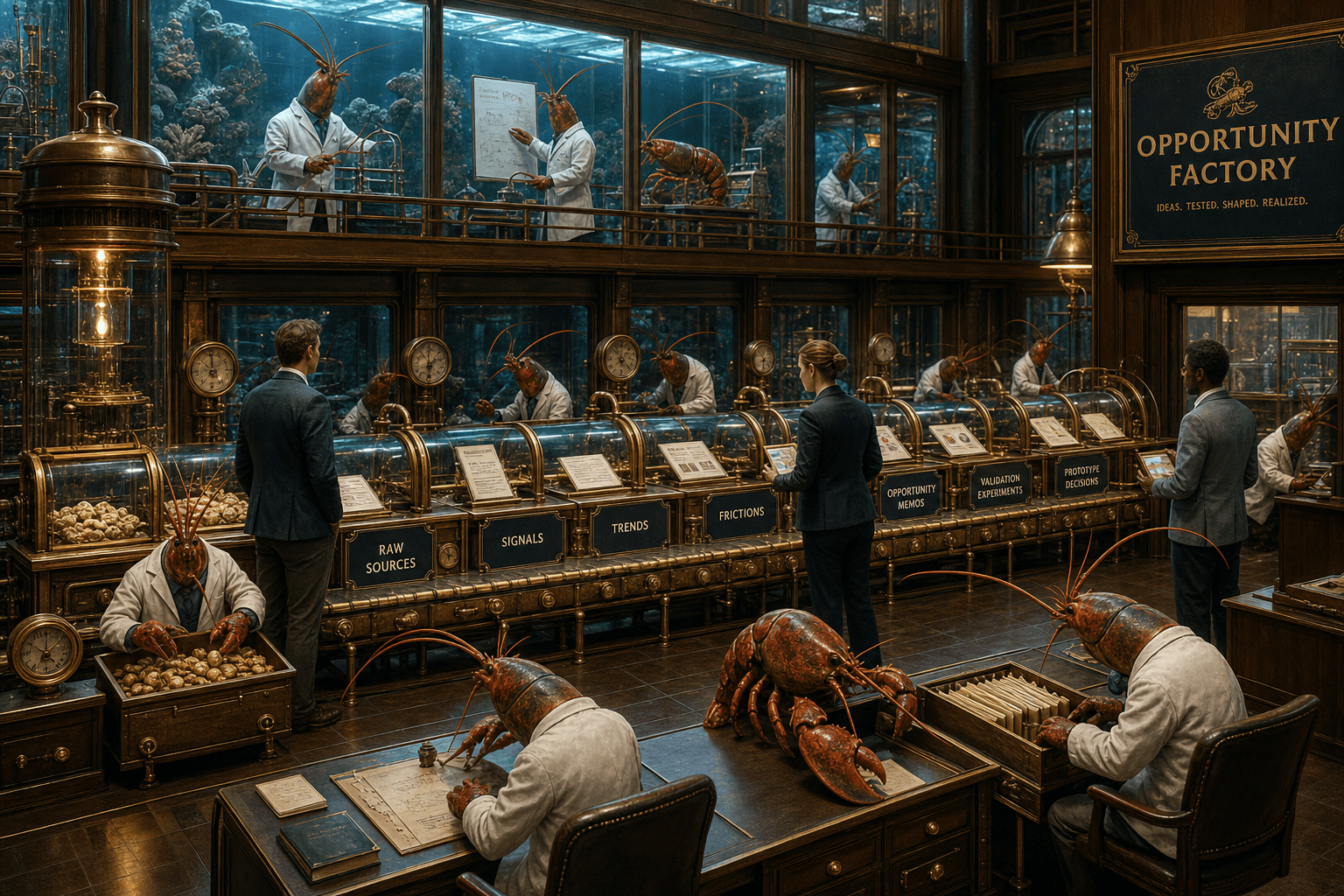
The end result is continuously-running pipeline that mines a wide variety of sources for opportunities, scores them against a structured rubric, runs cheap experiments against the survivors, and feeds every outcome back into the system so it gets sharper over time.
The by-product of ingesting content and processing through Claws for synthesis and having them compare notes is to come up with non-obvious opportunities that we might want to pursue.
The hypothesis is fairly straight forward: If we can cast a wider net to surface ideas for a diverse set of sources, that's a competitive advantage. If we can automate as much of due diligence process, kill off ideas quickly, and surface the signal from the noise from that wider data set faster than most, we win.
While the cost of shipping software is shrinking, it's not zero and if figure out a way to place a higher number of better bets quickly, then we can spend our time and energy on the ones that are more likely to yield results.
On the division of labor
Agents are very good at searching out, collecting, and synthesizing information. Humans are very good at creativity and connecting disparate ideas and experience together to see the relationships between non-obvious pieces of information. A core tenet is to build the workflow in such a way that we're able to both recognize that distinction and optimize for it.
At the same time, humans have been known for using an assortment of tricks over the centuries in order to kickstart creativity. Writing prompts are a great example of this. As we dig into the details below, we'll explore how we could potentially leverage some of these techniques with our agents in order to try to get our Claws to engage in similar exercises.
NOTE
There are smaller milestones along the way.
This document seeks to walk a fine—and possibly, ill-advised—line between being North Star and reasonable scope for a one-year or so time horizon. There are smaller milestones along the way. Any one of the phases listed above can be shipped individually and start providing value immediately. Any given phase can and should be scoped down to a smaller MVP along the way—but, I think it's useful to get a sense of how a somewhat robust version of the system might operate and then work back from there.
Terms of Art
A few concepts the rest of the document leans on. None are novel; but it certainly doesn't hurt for us all to get on the same page up front.
- Persona: a catch-all for a target customer, industry, or community—real estate agent, software engineer, public school teacher, dentist. Every opportunity we pursue is anchored to at least one persona. "Human" is not a persona; that's just lazy. In the early stages we want focus.
- Trend: a meaningful pattern of behavioral, market, cultural, or workflow change. Personas do not own trends. Personas are lenses. A trend can be broad, persona-specific, or both—and the most interesting ones show up across multiple personas with different surface manifestations. AI-assisted knowledge work is a broad trend; AI contract drafting is the lawyer-specific manifestation; AI lesson planning is the teacher-specific manifestation. Same underlying current, different riverbeds.
- Source: where observations come from—Hacker News, a subreddit, a forum, a newsletter, an earnings call transcript, a niche Discord.
- Signal: an atomic observation pulled from a source, with a link back to the evidence. Is there a nuance we should add to a persona? An idea worth pursuing? A source the community references that we're not tracking? A persona we're not serving?
- Opportunity: the central unit of the pipeline. A structured hypothesis anchored to both a persona and a trend, with evidence, a scoring rubric, and a validation plan. An idea without a persona is a fantasy; an idea without a trend is a feature for an old market.
- Experiment: how we get Real World™ validation that our—and our Claws'—intuition is correct. This could be as simple as a landing page with some product details, pricing, and a sign-up form, with Google AdWords driving traffic so we can compare conversion against our other ideas.
- Claw: an automated agent in OpenClaw, configured with one or more Markdown-defined skills and run on a scheduled, webhook-triggered, or manually invoked basis. A skill is the bundle of instructions the agent loads; the Claw is the agent that loads them. Every model call is logged via OpenTelemetry, and every output lands in a human queue before it changes anything. Persona Claws own personas, the Scout Claw hunts for new ones, the Market Analyst Claw scores opportunities, the Skeptic Claw critiques everything, and so on. More on each one as they show up.
The pipeline, at a high level
What the pipeline actually does, end to end:
- Ingest sources continuously—Hacker News, Reddit, forums, earnings calls, niche newsletters, transcripts, community feeds.
- Extract signals from raw content with evidence links back to source, then cluster signals into trends and frictions.
- Generate ideas by combining what we know about the personas we're tracking, their wants, their, needs, and frustrations—as well as some other methods that I'll dive into in a bit.
- Automate the due diligence: TAM estimate, competitor landscape, community map, major-player roster—all assembled by Claws and queued for us humans to review.
- Validate survivors with experiments—persona-specific landing pages, pricing tests, qualification surveys, ad variants, qualitative interviews, concierge MVPs. Scored on seven weighted dimensions producing one of five decisions: kill, revise, validate more, concierge MVP, or prototype.
- Learn from every kill and every win—sharpening persona profiles, pattern weights, scoring rubrics, and the strategic thesis itself on a quarterly cadence. No matter what the outcome is—we make sure we turn that into a feedback loop so that our system gets better over time.
Idea Farming
Idea farming seeks to keep our collective finger-on-the-pulse of industry trends and—more importantly—the wants, needs, and frustrations of potential customers. But, the goal here is to have lots of fingers on lots of pulses and separate the signal from the noise and analyze content at scale.
We'll discuss the system for ingesting data, surfacing signals, and generating ideas—which I'll call opportunities in a moment, but let's take a beat and talk about how all of these things relate. An opportunity always anchors to both a persona and a trend. An idea without a persona is a fantasy; an idea without a trend is a feature for an old market.
Decision ownership in Idea Farming: Adding new sources, adopting a new persona, and retiring one are human calls. At first, we want to make sure that the breadth of this system isn't ballooning for the sake of ballooning, just because a Claw got overly enthusiastic. Opportunity promotion from the curation board into Idea Validation is also a human call, with a written rationale logged on the artifact. Anyone reviewing the work can propose a kill; kill calls also need a name and a rationale on the record.
Over time, we can potentially optimize the system to have a bit more autonomy. But, as I asserted above: Humans are the arbiters of taste and intuition.

Sources we ingest
Sources come in two flavors: general (Hacker News, Reddit, earnings calls, broad social feeds, general technology news—anything that might surface relevance for multiple personas) and persona-specific (a subreddit for real estate agents, a forum for dentists, an industry newsletter for paralegals, a Discord for high school math teachers—anything we already know belongs to one persona). Each flavor takes a different path through the pipeline, but both share the same ingestion machinery underneath.
In terms of a roadmap, we can start with the general feed and build out abstractions for different types of sources, but I do think the personal-specific analysis is where things get interesting.
The shared part is the boring part. We build common tooling for the source types we keep running into: RSS readers, the Reddit API, a Hacker News firehose, transcript drops, a forum scraper for sites without APIs.
Each connector knows how to pull content from one kind of place, hash it, dedupe it, and drop the raw payload into object storage with provenance metadata. That layer doesn't care about personas; it cares about getting bytes onto disk reliably and noticing when a source goes dark. We figure out some of the common shapes of feeds we want to ingest and then build out some abstractions that make it trivial to additional sources in the future.
What happens next depends on which flavor of source the content came from.
%% Source routing
flowchart LR
  G["General sources"] --> C["Classifier"]
  P["Persona-specific sources"] --> PC["Persona Claws"]
  C -->|"fan out"| PC
- General sources fan out through a classifier. A new piece of content lands, a lightweight model call (or, for a lot of the easy cases, embedding comparison against the persona-profile vectors) decides which personas this might apply to. The classifier is generous: when in doubt, route to more personas rather than fewer. False positives are cheap—a persona's Claw can ignore something in milliseconds—but a false negative means a real signal disappears.
- Persona-specific sources skip the classifier entirely. If a source is subscribed to a persona's Claw, new content goes straight there. No routing decision needed; the routing already happened when the source got registered.
Either way, the content lands in front of a Persona Claw.
Persona Claws
Every persona has a dedicated Persona Claw with its own memory—the Claw's accumulating perspective on the persona it owns, and that hydrates automatically on every new session. The way that OpenClaw's memory architecture works under the hood and the fact that a given Claw is basically an isolated memory namespace works extremely well for what we're trying to do here.
The dentist Claw's memory store is a separate workspace from the teacher Claw's; the dentist Claw reads a lot of insurance-billing complaints, sees the same workflow tools mentioned across years of dentist forums, and gets quietly opinionated about what dentists actually care about versus what they say they care about. The Claw watching the real estate agent persona is doing the same thing in its own memory store: listing copy, lead-generation platforms, brokerage politics. These Claws don't share a brain. They share a roster.
When content arrives—either fanned out by the classifier or pushed directly from a subscribed source—the Persona Claw evaluates it against everything it already knows about its persona and decides whether it's relevant. Relevant content becomes signals, gets tagged to the persona, and flows into the rest of the pipeline. Irrelevant content gets logged and dropped: we keep the audit trail of what was rejected and why, because that record is how we tell whether a Claw is being too generous or too stingy. (Also: I don't want to waste tokens processing the same piece of content twice.)
OpenClaw is a natural fit for this. It's ability to react to events allows it to process information as it comes it and it's ability to run background tasks on a regular interval allows us proactively take on work in between.
In their downtime—when the pipeline isn't shoving fresh content at them—Persona Claws hunt for new sources. The dentist Claw notices it keeps seeing references to a niche podcast it isn't subscribed to and proposes adding it. The teacher Claw notices a Discord server that keeps coming up in its evaluation comments and proposes subscribing. New source proposals land in the human review queue with the Claw's reasoning attached—nothing gets added to the ingestion list without me signing off, but the Claws are the ones surfacing candidates.
Every ingestion cycle also refines the persona profile—across both memory layers. The structured slice (communities, influencers, vocabulary, the workflow tools people actually pay for, the TAM estimates, the registered sources) gets written transactionally to Postgres so other Claws and the internal curation dashboard can query it.
The Claw's own evolving understanding (the half-formed hypotheses it wants to revisit, the patterns it has noticed but hasn't formalized, the predictions it's still mad about getting wrong) goes into its memory store. A Persona Claw a year into operation knows more about its persona than the day-one version did because both layers compound—the database in clean structured rows, the memory store in long-form prose the Claw can read back next session and build on.
Finding personas we don't have a Claw for yet
Per-persona Claws are great at owning the personas we already know about. They're worthless at noticing the persona we don't. If a coherent new audience starts showing up in our general feeds—municipal arborists complaining about permit software (a story as old as time), indie game studio producers wrangling contractor payroll, hospital chaplains drowning in compliance documentation—nothing in the per-persona setup will see it. Each existing Claw is looking through its own lens and ignoring the rest.
That's the Scout Claw's job. It watches the general source feed and samples across every persona-specific feed, looking for clusters of signals that don't map cleanly onto any existing persona. When it finds one, it proposes a candidate persona: rough sketch of the role, sample evidence, candidate sources that already exist in the ingestion layer, and a one-paragraph case for why this group is worth spinning up a dedicated Claw for.
TIP
A word on sequencing and milestones
The Scout Claw probably isn't the first thing to work on. Most of the work initially will be optimizing the ability to ingest content and synthesize it, but the nice part is that this purely a progressive enhancement and can be added at any time.
It also scores and ranks every candidate. Running a new Persona Claw is not free—synthesis-grade model calls add up, the per-run hydrate/snapshot cycle against Postgres adds up, the time I spend curating its outputs adds up. The Scout's job is to make those costs legible. The scoring rubric: signal volume (how often is this persona showing up in the feeds?), signal coherence (do the signals share workflow vocabulary, or am I pattern-matching on noise?), economic plausibility (does this persona look like a buyer or a charity case?), distinctness from existing personas (is this actually new, or a re-skin of one I already cover?), and source availability (are there enough findable sources to keep a new Claw fed?).
Ranked candidates land in the human review queue. I decide which ones get promoted into a new Persona Claw, which ones get dropped, and which ones get parked as "interesting, but not yet."
Persona Claws compare notes
A standing Weekly Source Review is where I look at source coverage, freshness, persona representation, the new sources each Persona Claw proposed that week, and the candidate personas the Scout Claw surfaced. I deliberately seed lower-AI-readiness personas (teachers, dentists) into the initial source mix so the curation queue does not collapse into Tech-Bro Consensus®.
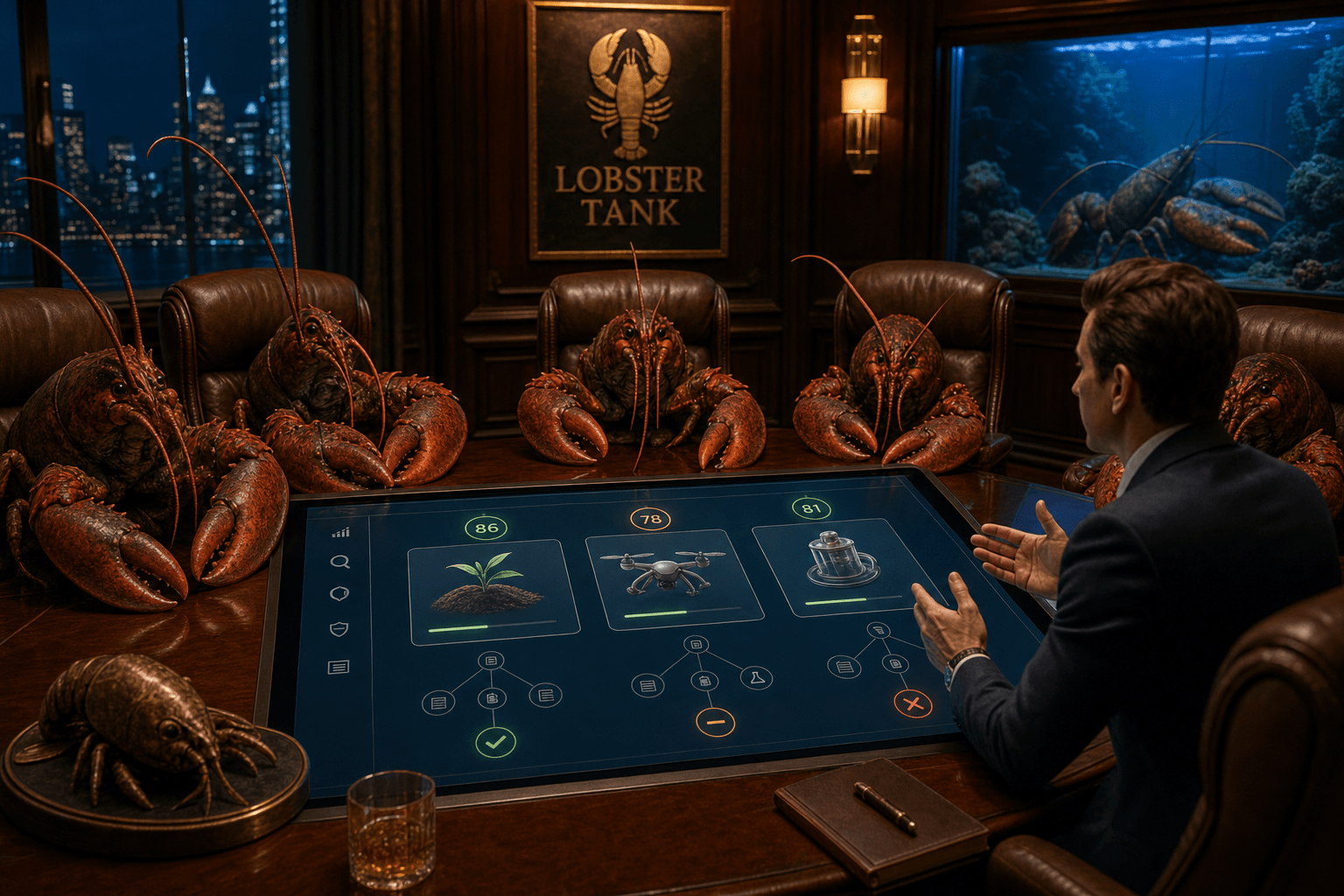
(Pay no attention to the fact that there is a lobster on a plate in the illustration above.)
So far each Persona Claw has been described as a lonely specialist sitting in its own cubicle reading the dentist forums. But, that's not how humans work. What makes humanity special is our ability to share ideas and compare notes.
The interesting opportunities almost never live cleanly inside one persona—they live in the seams. A workflow pattern that's well-established for software engineers might be revelatory for paralegals; a billing fracture that's old news for dentists might be a brand-new opportunity for veterinary clinics. Nobody sees those transfers unless somebody puts the Claws in a room together.
On a regular cadence, every Persona Claw publishes a digest of what it has learned recently: new frictions surfaced for its persona, workflow tools it's seeing show up, vocabulary shifts, anything that's changed in its persona profile. Every other Persona Claw reads those digests and asks the question that drives the whole exercise: is there a version of this that applies to my persona?
%% Cross-Persona Digest peer reads
flowchart LR
  D["Dentist Claw"] -- "digest" --> T["Teacher Claw"]
  D -- "digest" --> L["Lawyer Claw"]
  T -- "digest" --> D
  T -- "digest" --> L
  L -- "digest" --> D
  L -- "digest" --> T
That question has a name. It's the Hollywood Method.
The Hollywood Method
The Hollywood Method is a shorthand pitching technique where you explain a new idea by combining a familiar concept with a new domain, audience, or twist. The structure is usually "X, but for Y" or "X meets Y." Hollywood loves this because executives are terrified of uncertainty and deeply comforted by recycling. Humanity built the moon landing and CRISPR, yet entire industries still communicate primarily through "Uber for dogs." We're a remarkable species.
Good versions work because they instantly transfer emotional tone, mechanics, audience expectations, and market positioning. A few genuinely strong examples:
- Toy Story, but with koalas—instantly suggests anthropomorphic emotional storytelling, ensemble characters, humor, and adventure.
- Die Hard on a bus—this was literally the pitch for Speed.
- Jaws in space—essentially Alien.
- The Office in a parks department—that becomes Parks and Recreation.
- Harry Potter and the Sorcerer's Stone meets detective noir—basically the DNA of The Name of the Wind mixed with mystery structure.
- Ocean's Eleven with magicians—that's Now You See Me.
- John Wick with nobody-level suburban dads—more or less Nobody.
- Airbnb for pets—communicates marketplace dynamics, trust systems, temporary stays, peer-to-peer inventory.
- GitHub for machine learning models—this is effectively what Hugging Face became.
- Stripe for AI agents—implies developer-first APIs, infrastructure abstraction, and payments/coordination rails for agent ecosystems.
The best Hollywood Method pitches do three things immediately: transfer a known emotional experience, clarify the audience, and reveal the novelty in under ten seconds. Bad ones are just taxonomy soup—"It's Slack meets blockchain meets TikTok for dentists"—which usually means "we have no idea what this is, but investors were trapped in a conference room long enough to nod politely."
For Persona Claws, the Hollywood Method is the engine of cross-persona transfer. When the software-engineer Claw publishes a digest about how AI code review tools are reshaping pull-request workflows, the lawyer Claw reads it and asks "AI code review, but for contract redlines?" The dentist Claw reads it and asks "AI code review, but for treatment-plan documentation?" Most of those questions die immediately—the workflow topology doesn't actually match, or the persona doesn't have the budget, or the regulatory layer kills it. But the ones that survive become opportunity candidates flowing into the rest of the pipeline.
Other methods at the same meeting
Hollywood is the headliner, but it's not the only tool Persona Claws bring to their digests. The full set lives in the Pattern Library section later in the document, but the ones that show up most often when Claws are comparing notes:
- Shopify Method: democratizing a capability that previously required expertise or enterprise tooling. A Persona Claw asks "what's something my persona pays an agency for that they could now do themselves with AI?"
- Stripe Method: abstracting painful infrastructure behind developer- or workflow-friendly primitives. A Persona Claw asks "what's the duct-taped integration my persona is rebuilding every quarter?"
- Cursor Method: embedding AI inside an existing high-frequency workflow rather than making users visit a separate tool. A Persona Claw asks "where does my persona already spend their day, and how could AI live inside that surface?"
- Compliance Automation Method: converting mandatory procedural work into monitored background automation. A Persona Claw asks "what's the form my persona dreads filling out every month?"
The point of the meeting is not for one Claw to declare the right answer. The point is for ten Claws asking ten different versions of "could this apply to me?" to produce a much larger candidate set than any single Claw could generate on its own. The curation board then sorts the wheat from the taxonomy soup.
NOTE
Cadence
The Cross-Persona Digest runs weekly. Each Claw publishes a token-capped digest (new frictions, new tool mentions, vocabulary shifts), then opens a fresh session whose skill allowlist was set by the Pattern Library router (see the pattern library) based on the digests being read. Transfer candidates flow into the curation board alongside primary opportunity memos.
Persona intelligence

A persona is a bundle: workflows, incentives, budgets, anxieties, constraints, communities, influencers, and the software they already pay for. We are not trying to know who the user is—we are trying to know whether the user has recurring pain, workflows, visible communities, adoption pressure, and a distribution channel we can reach.
NOTE
The types are pseudocode-ish
I think in types. If that's not your jam, skim the code blocks—the prose carries the load. Besides, they're pseudocode anyway.
type Persona = {
  id: string;
  name: string;
  industry: string;
  related_roles: string[];
  // Economic profile
  market_size: {
    tam: number;
    sam: number;
    som: number;
    method: 'top_down' | 'bottom_up';
  };
  willingness_to_pay: {
    who_pays_today: string;
    software_spend_usd: number;
    labor_spend_usd: number;
  };
  buyer_vs_user: 'same' | 'different' | 'committee';
  ai_readiness: {
    // AI readiness (drives the AI Readiness Index)
    adoption_stage: 'early' | 'experimenting' | 'productionizing' | 'mature';
    digital_workflow_maturity: number; // 0-1
    technical_literacy: number; // 0-1
    regulatory_resistance: number; // 0-1
    competitive_pressure: number; // 0-1
    information_work_ratio: number; // 0-1
    data_accessibility: number; // 0-1
  };
  workflow_stack: {
    // Workflow profile
    tools: string[];
    spreadsheets: string[];
    manual_processes: string[];
  };
  core_workflows: string[];
  pain_points: string[];
  handoffs: string[];
  communities: {
    // Ecosystem
    name: string;
    platform: string;
    size?: number;
    norms: string;
  }[];
  influencers: {
    name: string;
    platform: string;
    representative_work: string;
  }[];
  conferences: string[];
  publications: string[];
  vendors: string[];
  // Market dynamics
  fragmentation: 'high' | 'medium' | 'low';
  incumbent_strength: 'high' | 'medium' | 'low';
  switching_costs: 'high' | 'medium' | 'low';
  distribution_channels: string[];
  constraints: string[]; // regulatory, trust, procurement, integration, cultural
};
The AI Readiness Index estimates adoption velocity per persona—the same opportunity can be too early for one persona and immediately viable for another. The factors: digital workflow maturity, economic incentive alignment, information work ratio, competitive pressure, existing software spend, regulatory resistance, technical literacy, data accessibility. A software engineer and a real estate agent might both be affected by AI-assisted work, but they will adopt different products for different reasons.
For example, we know that a large number of software engineers have adopted agentic coding tools and we can make some small bets about the next ring of professions: real estate agents or lawyers, potentially. On the opposite side of the spectrum, monks are probably not the next group to hop on the bandwagon.
The persona profile updates continuously as signals arrive, snapshots daily, and surfaces to the human review queue any time the delta exceeds a configured threshold—so I can see when a profile is drifting and ask why before the drift is baked in. Before any persona's opportunity reaches prototype, I want at least one outside read from a practitioner or customer in that field—an outsider's perspective beats insider confidence here, and the Skeptic Claw isn't a substitute for someone who actually does the work.
Some of the scores are still a bit hand-wavy and we can always use those waving hands to adjust their values or their weights manually based on our own intuition.
Due diligence the system automates
A Persona Claw generates an idea. The next question is the obvious one: is this idea worth pursuing? The Market Analyst Claw exists to answer it numerically.
When a Persona Claw promotes an opportunity, the Market Analyst fires (webhook, synthesis-grade model) and runs the financial and market gauntlet. It does not re-discover communities, influencers, or workflow tooling—the Persona Claw already owns that standing knowledge. The Market Analyst's job is to take the idea, crunch the numbers, and return a pursuit recommendation with the reasoning attached. The reasoning lives across four scores, each a number between 0 and 1, each with a written justification linking back to source:
- Market size: is there actually money here? Estimates the serviceable obtainable market for this opportunity's wedge specifically—not the persona's total addressable market, but the slice the proposed product could realistically reach. Drawn from persona counts, average revenue/employee for the segment, willingness-to-pay benchmarks, and credible third-party reports cited inline. A persona of 50,000 buyers spending $200/year on adjacent tooling is a different number than a persona of 500 buyers spending $200,000/year.
- Competition density: how red is the ocean? Maps incumbents, well-funded startups, point solutions, agencies, and DIY workflows that target this wedge, sourced from search, GitHub, Crunchbase, and community mentions. Each competitor carries a one-line description, last funding event, and obvious moat. A wedge with three well-capitalized incumbents and twelve seed-stage startups is a Red Ocean and scores low; a wedge with one sleepy incumbent and a tangle of DIY workarounds is a Blue Ocean and scores high.
- Defensibility: what stops the second-mover? Looks for the structural moats that could accrue if this idea ships—proprietary data, workflow embedding, network effects, integration depth, trust accumulation, distribution lock-in. Ideas where the moat is "we shipped first" score low; ideas where the moat is "we own the data pipeline that everyone else has to integrate with" score high.
- Distribution feasibility: can we actually reach these buyers at a cost they justify? Uses the Persona Claw's standing community and influencer roster to estimate CAC against expected ACV. A wedge where reaching the buyer costs $400 of paid search to land a $99/month subscription scores low; one where the persona's existing trade publication will write about it for free scores high.
The four scores combine into a single pursuit score between 0 and 1, with weights I tune at the Quarterly Thesis Review. Low pursuit scores do not automatically kill an idea—I still decide at the curation board—but they require a written defense to override. "Looked exciting in the room" is not a defense.
NOTE
Inputs and outputs
The Market Analyst reads the opportunity memo, the persona profile that produced it, the linked trend, and the friction artifacts—no new crawling, just what the Persona Claw already cataloged plus standing connectors to Crunchbase-equivalent funding data and search APIs for competitive checks. Every score is a paragraph of rationale plus inline citations. Lands on the curation board alongside the memo and the Skeptic critique.
Trend intelligence
A trend is a pattern that explains why a workflow or market is changing. It becomes useful when it points toward friction, timing, or transferable opportunity. A trend with no actionable downstream is just a Twitter thread.
In terms of sequencing, this can probably come a bit later on—just like the Scout Claw that we discussed previously. That said, it's would exploring conceptually up front.

type Trend = {
  id: string;
  name: string;
  scope: 'macro' | 'industry' | 'workflow' | 'persona_specific';
  persona_ids?: string[]; // optional; trends can span personas
  supporting_signal_ids: string[]; // minimum 3 to be named a trend
  scoring: {
    evidence_strength: number; // 0-1
    cross_domain_reach: number; // 0-1
    acceleration: number; // 0-1
    non_obviousness: number; // 0-1; weighted heaviest
    actionability: number; // 0-1
  };
  composite_score: number;
  status: 'candidate' | 'monitored' | 'promoted' | 'retired';
};
Trends operate at four resolutions:
- Macro: AI-assisted knowledge work becomes normalized.
- Industry: real estate agents use AI for listings and follow-up.
- Workflow: (professionals draft regulated documents with AI.
- Persona-specific: (teachers draft parent communications with AI.
Non-obviousness does the most work in scoring: if the trend is already on the cover of a magazine, we are late. We didn't need to build this system just to surface up obvious trends and ideas, right?
NOTE
Extraction is plumbing
Trend, friction, and workaround tagging are heartbeat jobs on a fast-extraction model—plumbing, not Claws. Trend candidates require at least three supporting signals (never one anecdote). Workaround detection (DIY processes, spreadsheet glue, copy-paste loops, manual reconciliation) gets its own pass because it's the single most valuable signal in the system. None of these jobs can promote anything—that's a curation-board call.
Opportunity scoring
As I said earlier:
The by-product of ingesting content and processing through Claws for synthesis and having them compare notes is to come up with non-obvious opportunities that we might want to pursue.
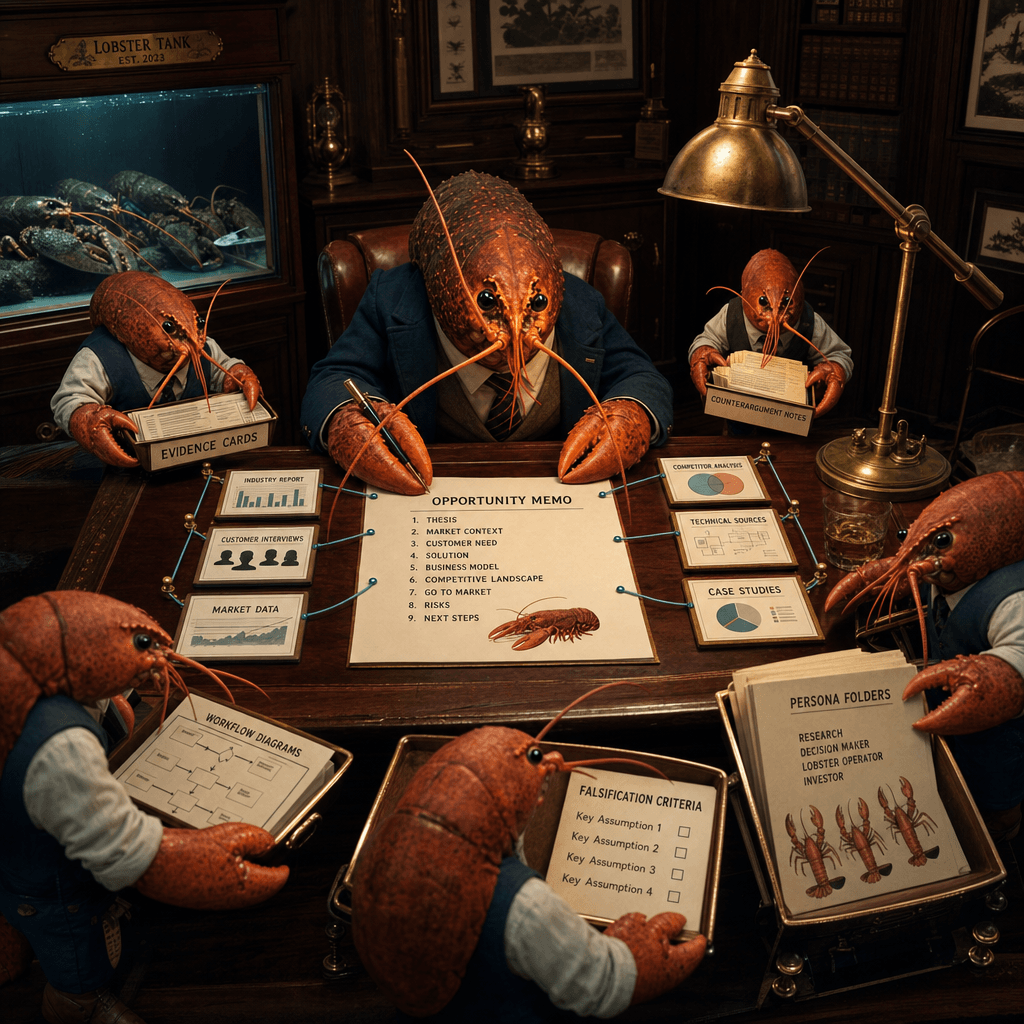
An opportunity is not an idea name on a sticky note. It is a structured hypothesis that connects a persona, a trend, a workflow, a friction, a capability, a timing rationale, a competitive gap, a distribution path, and a validation plan. Persona and trend are the two required anchors—an opportunity that cannot name both does not get a memo.
type Opportunity = {
  id: string;
  name: string;
  persona_ids: string[]; // required, primary + secondary
  trend_ids: string[]; // required, at least one
  workflow_ids: string[];
  friction_ids: string[];
  capability_ids: string[]; // AI capabilities making it viable now
  pattern_ids: string[]; // Hollywood, Shopify, Cursor, etc.
  memo: {
    // The opportunity memo (narrative)
    thesis: string;
    why_now: string;
    ai_advantage: string;
    prototype_concept: string;
    distribution_hypothesis: string;
    falsification_criteria: string; // what would make us reject this
    mystic_note: string; // first-person, what it FEELS like; cannot be empty
    artist_note: string; // what the artifact should feel like as a gift; cannot be empty
  };
  score: {
    // Ten-factor score, multiplicative against the right-to-build filter
    pain_severity: number;
    frequency: number;
    economic_impact: number;
    ai_advantage: number;
    prototype_speed: number;
    distribution_accessibility: number;
    competition_density: number;
    defensibility: number;
    composite: number;
  };
  validation_plan?: ValidationExperimentConfig;
  status:
    | 'draft'
    | 'reviewing'
    | 'promoted'
    | 'validating'
    | 'rejected'
    | 'archived';
};
Each opportunity is evaluated against a number of factors: pain severity, frequency, economic impact, AI advantage, prototype speed, distribution accessibility, competition density, and defensibility. All of these are obviously up for discussion.
There are two interesting ones hidden here: the Mystic Note and the Artist Note. If the mystic note explains the future, the artist note explains the soul. An a good opportunity has both: The mystic note explains why the company matters historically; the artist note explains why users love it emotionally.
Mystic Note
Mystic Note is a first-person prose about what the opportunity feels like. Not the market case, not the score. The moment from a real interaction with the persona that made you realize the opportunity exists.
- “Software is becoming autonomous.”
- “Every industry with coordination problems eventually becomes a network.”
- “AI agents will become the operating system for work.”
- “People don’t want social media, they want status infrastructure.”
The point is not that the statement is fully provable today. The point is that it reframes the world in a way that feels prophetic. Good mystic notes create gravity. They make investors and early employees feel like they are participating in history rather than merely joining another SaaS company that helps dentists schedule appointments more efficiently. Humanity’s true calling.
Artist Note
An Artist Note is more about taste and emotional intent. Why does this product exist aesthetically or philosophically? What experience should users feel? What does the creator care about at a deep level?
- “We want software to feel calm instead of managerial.”
- “We believe tools for developers should feel empowering, not bureaucratic.”
- “This product should feel like a trusted companion, not enterprise software.”
- “We want online collaboration to feel playful and alive.”
NOTE
This will likely need human involvement.
I'd love to be wrong about this, but I'd be remiss that I'd call out that I'm not totally sold on a models ability to do this with any fidelity. Luckily, this doesn't have to be a one-way door.
Microscopic case study
Let's explore a fictitious example, AI Review Copilot for Insurance Claims:
- Thesis: claims adjusters review repetitive, high-stakes documents across fragmented systems; AI code review patterns may transfer to claims review because both workflows require structured artifact inspection, inconsistency detection, and evidence-backed recommendations.
- Mystic Note: "I keep coming back to the moment an adjuster told me she rereads packets at home because she does not trust her own first-pass review. The opportunity is not faster review. The opportunity is giving her the second opinion she has been giving herself for fifteen years."
- Artist Note: "The product should feel like a careful colleague sliding a sticky note across the desk—never an alarm, never a chatbot, never a dashboard. The adjuster should close her laptop at five and trust that nothing important was missed."
The pattern library

A Pattern is a reusable innovation transformation—a method that, given a trend or friction, produces a new opportunity hypothesis. We saw a few of them before when we talked about the Hollywood Method and others. Patterns are not labels you attach after the fact. They are generators. The library is tuned over time by tracking which patterns produce ideas that survive validation.
These are ways to hopefully trick the Claws into generating some unexpected insights that they can investigate to see if there are any hidden opportunities.
Under the hood, the Pattern Library is a collection of skill bundles—prompt template, output schema, applicability criteria, and a track record—plus the routing layer that decides which bundles a Persona Claw should have access to on a given run. That routing layer matters: OpenClaw snapshots an agent's skill list when a session starts and reuses it for the duration, so "load the right bundle dynamically based on what the Claw is currently looking at" isn't a thing the platform does. Skill selection has to happen before the session starts.
The router is a small Postgres-and-prompt-template service (plumbing, not a Claw): given a digest's contents or a draft memo's friction-and-capability tags, it queries the Pattern Library, ranks bundles by their applicability_criteria match, and starts the Persona Claw's session with the top-K bundles allowlisted. The Persona Claw then has those bundles available as skills in the usual OpenClaw way. The router is the reason applicability_criteria is a useful field—without it, every Claw would have to either carry the full library in its session prompt (expensive) or run one fresh session per bundle (slow). The router handles the trade-off.
type PatternBundle = {
  id: string;
  name: string; // e.g., "Hollywood Method", "Cooperative Method"
  mechanism: string; // one-sentence summary of how it transforms an input
  prompt_template: string; // the instantiation prompt a Claw loads to apply this pattern
  output_schema: JSONSchema; // the structured shape the application must produce
  applicability_criteria: string[]; // conditions under which the bundle is worth loading
  anti_patterns: string[]; // conditions that should cause the bundle to abort
  required_capabilities: string[];
  failure_modes: string[];
  examples: { company: string; outcome: string }[];
  performance_metrics: {
    times_applied: number;
    curation_promotion_rate: number;
    validation_survival_rate: number;
    prototype_outcomes: { passed: number; killed: number };
  };
};
The Reflection Claw (discussed later) recomputes performance_metrics quarterly. Bundles with sustained bad ratios get retired or refined; new bundles get added when I write them and approve them at the Quarterly Thesis Review. Adding a new pattern means writing a bundle file, not deploying a new Claw.
output_schema is a contract the database enforces at write time, not something OpenClaw validates inside the Claw. Same rule as the rest of the system: the operational database rejects any artifact whose shape doesn't match the schema or whose evidence chain doesn't resolve back to underlying signals. The schema lives on the bundle so the Claw can be prompted to produce the right shape; the rejection lives in Postgres so the guarantee is structural, not vibes.
The obvious patterns are all Silicon Valley archetypes. They are useful, but they narrow imagination if they are the only patterns the library knows. The interesting bets often live where two unfashionable things meet—software plus craft, data plus lived experience, technology plus civic infrastructure. The library has a second tier for exactly that reason.
SaaS and platform archetypes:
- Hollywood Method: transpose a trend from one persona to another.
- Shopify Method: democratize a capability that required expertise.
- Palantir Method: unify fragmented operational data.
- Stripe Method: abstract painful infrastructure.
- Cursor Method: embed AI inside an existing high-frequency workflow.
- Rippling Method: orchestrate cross-system operational workflows.
- Figma Method: collaborative multiplayer.
- Zapier Method: automation glue.
- Bloomberg Method: aggregate fragmented information into a decision terminal.
- Compliance Automation Method.
- Memory Layer Method.
- Cost Collapse Method.
Non-SaaS archetypes — the patterns that produce companies the Valley defaults do not see:
- Public Health Method: structure a service as a care pathway—artifact is a relationship, not a SKU.
- School Method: cohorts, sequences, credentialing.
- Civic Infrastructure Method: the boring shared layer everyone needs and nobody owns.
- Cooperative Method: ownership structured so the people doing the work own a piece.
- Cultural Institution Method: operate like a museum or music label—asset is taste plus reputation.
- Creative Production Method: industrialize the non-creative parts of creative work.
- Open-Source Ecosystem Method: steward a public commons.
- Service Business Method: deliver the outcome as a service first; graduate to a product when the workflow is stable.
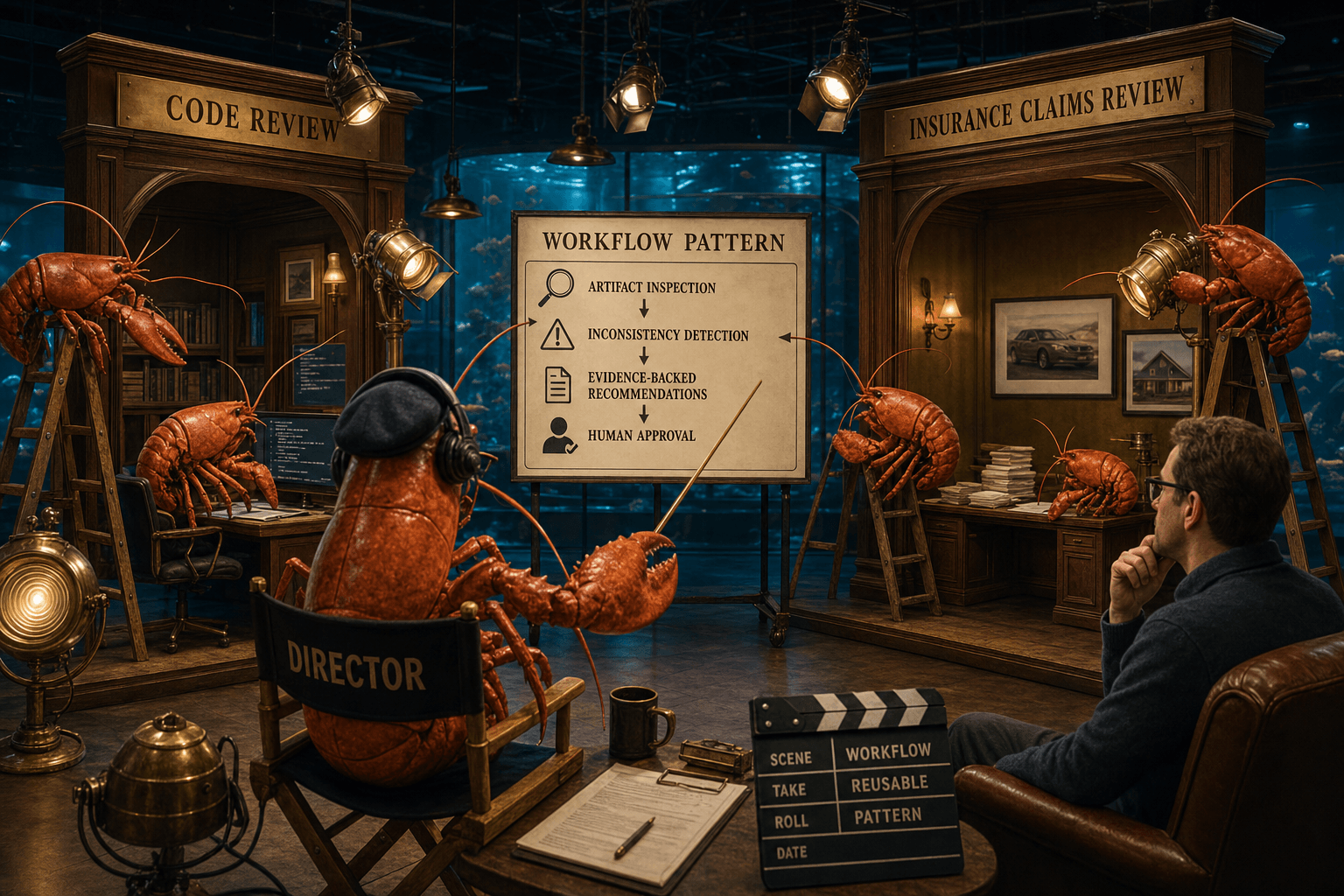
The Hollywood Method is the engine of cross-persona transfer—the full definition, examples, and the "X, but for Y" framing live earlier in the doc where Persona Claws apply it to each other's digests (see The Hollywood Method). One technical rule the Pattern Library enforces on every Hollywood-style transfer, regardless of who proposed it:
WARNING
The transfer rule
The system should not just copy product names across industries. It extracts the underlying workflow topology, then tests whether the target persona has equivalent artifacts, incentives, constraints, and willingness to pay. "AI code review, but for X" is a bad opportunity by default. "Code review topology applied to X, where X has the matching ingredients" is a candidate.
NOTE
When bundles get loaded
Bundle selection happens at session-start time, not mid-session. The router fires twice: once when the Cross-Persona Digest job spawns a Persona Claw's weekly session (allowlisting bundles whose applicability criteria match the digests being read) and once when an opportunity memo session opens (allowlisting bundles that match the memo's friction-and-capability tags). Every bundle application within the session is its own trace, with bundle id and prompt_template version recorded—that's how the Reflection Claw scores pattern performance later.
Four non-SaaS worked examples
The machinery has to run on more than SaaS. Four sketches, each running the same right-to-build filter, ethics gate, and validation experiment as anything else:
- Apprentice Cooperative for Independent Trades (Cooperative Method). Electricians, plumbers, HVAC techs lose 20–30% margin to lead-gen platforms while apprentice pipelines collapse. A user-owned cooperative pools lead generation, continuing-education subsidies, and back-office software. Validation: six-week paid pilot with 15 founding-member trades in one metro. Kill criterion: fewer than 10 of 15 stay through week six, or zero recruit a second member.
- Civic Permitting Companion (Civic Infrastructure Method). Small municipalities run permitting on legacy software, paper, and tribal knowledge; residents lose weeks, staff burn out on phone tag. A companion built with a city's permitting office, not sold to it. Validation: 90-day paid pilot with one city, scoped to one permit type. Kill criterion: timeline does not compress measurably, or the city will not renew at a sustainable price.
- Regional Repertory Theater Operating System (Cultural Institution Method). Mid-sized theaters ($2M–$15M budgets) run on Tessitura, spreadsheets, volunteer labor, and burnout. A season-shaped operating system covering ticketing, donor management, season planning, and production budgeting. This one belongs in the Slow Track—hold for 12–24 months while the founder pipeline for arts administrators strengthens, validate season-long when activated.
- Community Health Worker Coordination Platform (Public Health Method). CHWs deliver outsized impact in underserved communities but lose hours weekly to multi-funder reporting in incompatible formats. A coordination platform built with a CHW program, not for one. Validation: 90-day paid pilot with one program of 20–40 workers, with the Six-Month Dignity Check binding at month six—public health is one of the categories where a bad product does the most concrete harm.
The Claw roster
The way to think about Claws is not "automated workers" but professionals—each one is the equivalent of a person you would hire for a specific job. They have memory. They have continuity. They get better at their job over time. They hand artifacts off to each other the way a small team would. The roster is short on purpose: as many Claws as we need, as few as we can get away with.
NOTE
This is not a hill that I'm willing to die on.
More than maybe any other part of this plan, this is probably the most up for debate. I think that in the act of building this system, we'll learn a lot and this will change significantly. The nice part is that the earlier ones (e.g. the Persona Claw) are probably the least controversial.
Here's the whole roster at a glance:
| Claw | Cadence | Reads | Writes |
|---|---|---|---|
| Persona Claw (one per persona) | Continuous | Incoming signals routed to its persona; its own memory store; persona's structured slice in Postgres | Filtered signals, opportunity memos, persona-profile updates |
| Scout Claw | Weekly | Sampled slice of general feed + stratified sample of persona-specific feeds | Candidate new-persona proposals (human review queue) |
| Market Analyst Claw | Webhook on memo promotion | The drafted memo, persona profile, linked trend, friction artifacts | Pursuit score (4 dimensions + composite) with citations |
| Skeptic Claw | DB-write triggered (every memo, score, scorecard) | The artifact under review + its evidence chain | Critique artifact alongside the original |
| Web Developer Claw | On experiment publish | Experiment config | Draft landing pages, pricing tables, surveys (preview env, human-released) |
| Marketer Claw | On experiment publish | Experiment config, channel history | Campaign briefs, UTM-tagged links (queued, human-released) |
| Researcher Claw | Continuous during validation | Interview transcripts, concierge notes, uploaded artifacts | Coded transcript summaries, qualitative scorecard ratings |
| Reflection Claw | Quarterly | Postmortems, original memos + scorecards + critiques, Pattern Library bundle traces | Quarterly recalibration packet (proposed weight changes, retirements) |
Idea Farming Claws
- Persona Claws (one per persona): the domain analyst who has been reading the dentist forums for two years and knows what dentists actually care about versus what they say they care about. Synthesis-grade model, runs continuously, hydrates its persona profile from Postgres on every run and snapshots back at the end (see memory model). Evaluates incoming content for relevance, owns the persona profile (communities, influencers, tools, AI Readiness Index scores), hunts for new sources in its downtime, participates in the weekly Cross-Persona Digest, and writes the opportunity memos for its persona. See Sources we ingest and Persona Claws compare notes.
- Scout Claw: the scout looking for personas worth adding to the roster. Cron weekly, synthesis-grade model. Watches the general source feed and a stratified sample across every persona-specific feed, looking for clusters that don't map onto any existing persona. Proposes candidate new personas with scoring (signal volume, signal coherence, economic plausibility, distinctness from existing personas, source availability) so I can decide which deserve a dedicated Persona Claw. See Finding personas we don't have a Claw for yet.
- Market Analyst Claw: the person who does the financial sanity check on every idea before we invest in validation. Webhook (fires when a Persona Claw promotes an opportunity), synthesis-grade model. Crunches market size, competition density (Red Ocean vs Blue Ocean), defensibility, and distribution feasibility into a single pursuit score with reasoning attached. Does not re-discover communities or influencers (the Persona Claw owns that). Low scores require a written defense to override at the curation board. See Due diligence the system automates.
Idea Validation Claws
- Web Developer Claw: owns the experiment's web surface. Landing pages, pricing tables, qualification surveys, the artifact-upload UI, the FAQ, the booking embed. Remembers which page structures convert for which personas and iterates variants accordingly. Drafts only; cannot push to production without an explicit publish action from a reviewer.
- Marketer Claw: owns demand generation across channels. Ad copy per channel, outbound email per persona, campaign briefs, UTM strategy, channel selection. Remembers which channels flop for which personas and reads the validation scorecard's channel-access dimension as feedback. Cannot spend ad budget or send mail to real addresses without human release.
- Researcher Claw: owns qualitative validation. Drafts interview scripts, codes transcripts after calls, summarizes concierge MVP session notes and uploaded artifacts, runs the Six-Month Dignity Check protocol when the calendar comes due. Carries continuity—remembers what each persona keeps saying across interviews even when nobody named it out loud.
Cross-phase
- Skeptic Claw: structurally independent critic. Runs as its own OpenClaw agent on a different model family from whichever Claw produced the artifact under review—so the critique isn't subject to the same model's blind spots. Triggered by the database write that lands a drafted memo, a pursuit score, or a validation scorecard—the same transaction writes an outbox row, the Temporal CDC subscriber starts a fresh Skeptic workflow. The upstream Claw cannot decide whether its own draft gets reviewed. Loads the adversarial-questions skill and writes a critique artifact back to the graph alongside the original. Cannot promote, kill, merge, or rename. The Skeptic exists to make the case against; humans decide whether the case sticks.
Reflection and Improvement Claws
- Reflection Claw: quarterly. Reads every postmortem from the last cycle, recomputes each Pattern Library bundle's track record, tests proposed scoring weight adjustments against actual outcomes, and produces a recalibration packet for the Quarterly Thesis Review. Does not write to the live rubrics or pattern bundles—every change is human-approved.
What's not a Claw
The word Claw should mean something. If we call every script and webhook handler a Claw, the word loses its weight. The things below get the job done in the pipeline but do not deserve the title:
- Ingestion connectors (RSS reader, Reddit API client, HN firehose, transcript dropper, forum scraper)—one per source type. They pull bytes onto disk reliably. No memory, no judgment, no model calls beyond format parsing.
- The classifier that routes general-source content to candidate Persona Claws. A single lightweight model call or vector similarity check per content piece. Stateless.
- The Pattern Library router that selects which skill bundles a Persona Claw's session should be started with. A SQL query plus a small ranking function—no judgment of its own; it just picks which generators the Claw can use.
- The hydrate/snapshot layer that loads persona profiles, recent signals, and scoring weights from Postgres at session start, and writes the deltas back at session end. Boilerplate, but boilerplate the whole architecture depends on.
- Webhook handlers that listen to PostHog, Stripe, and Cal.com and normalize events into the operational database. Plumbing.
- The quantitative half of the scorecard. A SQL query against the events table with an
ORDER BYclause. Not a Claw. - The Cross-Persona Digest scheduler, the curation board's queue routing, the experiment-config drafting on promotion. All function calls or scheduled jobs.
Naming these as plumbing rather than Claws keeps the architecture honest about where the actual reasoning lives. This is covered in greater detail it the Architecture section.
What every Claw owes the system
Every Claw's model calls, tool calls, and memory reads are logged via OpenTelemetry. Every artifact carries the trace ID of the Claw that wrote it, so any claim in any memo can be traced back to the run that produced it and the evidence it was looking at.
Memory is split between two layers, and getting the split right is the most important architectural detail in this document. OpenClaw sessions are independent—each new session starts with a fresh agent context. But OpenClaw gives every agent a memory store: a workspace-scoped, versioned document collection that the agent reads and writes via standard file operations, and that persists across sessions. The agent doesn't carry conversation history forward; it carries its accumulated notes, evolving opinions, and learned vocabulary forward in the memory store.
So memory works in two layers:
%% Memory model
flowchart LR
  C["Claw session"]
  C <--> M["Memory store<br/>(evolving understanding)"]
  C <--> P["Postgres<br/>(typed artifacts)"]
- Memory stores are where each Claw keeps its own evolving understanding. A Persona Claw's memory store holds its long-form notes on the dentist persona—the workflow vocabulary it's learned, the influencers it now recognizes, the half-formed hypotheses it wants to revisit, the failed predictions it's still mad about. Every mutation creates an immutable version, which is what makes the "every Claw run reviewable and reversible" rule structural. Memory stores survive across sessions; nothing resets them by default.
- Postgres is the system of record for everything that needs to be queried, joined, audited, or RLS-protected. Signals, opportunities, scorecards, evidence chains, scoring weights, the persona's structured profile (TAM numbers, named influencers, registered sources)—all in Postgres. This is the data shape that other Claws read, that humans review at the curation board, that the analytical layer rolls up quarterly.
The rule for which goes where: if it's a typed artifact that anything besides the originating Claw needs to read, it goes in Postgres. If it's the originating Claw's own evolving understanding—its mental model, its half-thoughts, the patterns it's noticed but not yet formalized—it goes in the memory store. The Persona Claw's "I keep seeing this billing complaint from three different dentist forums and it's starting to feel like a real pattern" lives in the memory store. The Persona Claw's "this is the pursuit score and these are the evidence links" lives in Postgres.
Every Claw run starts with two reads: the memory store hydrates automatically when the session attaches to it, and the Claw fetches the relevant structured slice from Postgres. Every run ends with the same two writes: a memory store update (auto-versioned by OpenClaw) and a structured Postgres write (transactional, RLS-checked, evidence-validated by trigger).
Two things Claws do not get to do (for now), in any configuration: no outbound communication (no email, no posts, no ad spend; drafts sit in queues until released by a human) and no status changes that close a decision (a Claw can write status: drafted or status: critiqued, never status: promoted, status: killed, or status: validating).
The pipeline, end to end
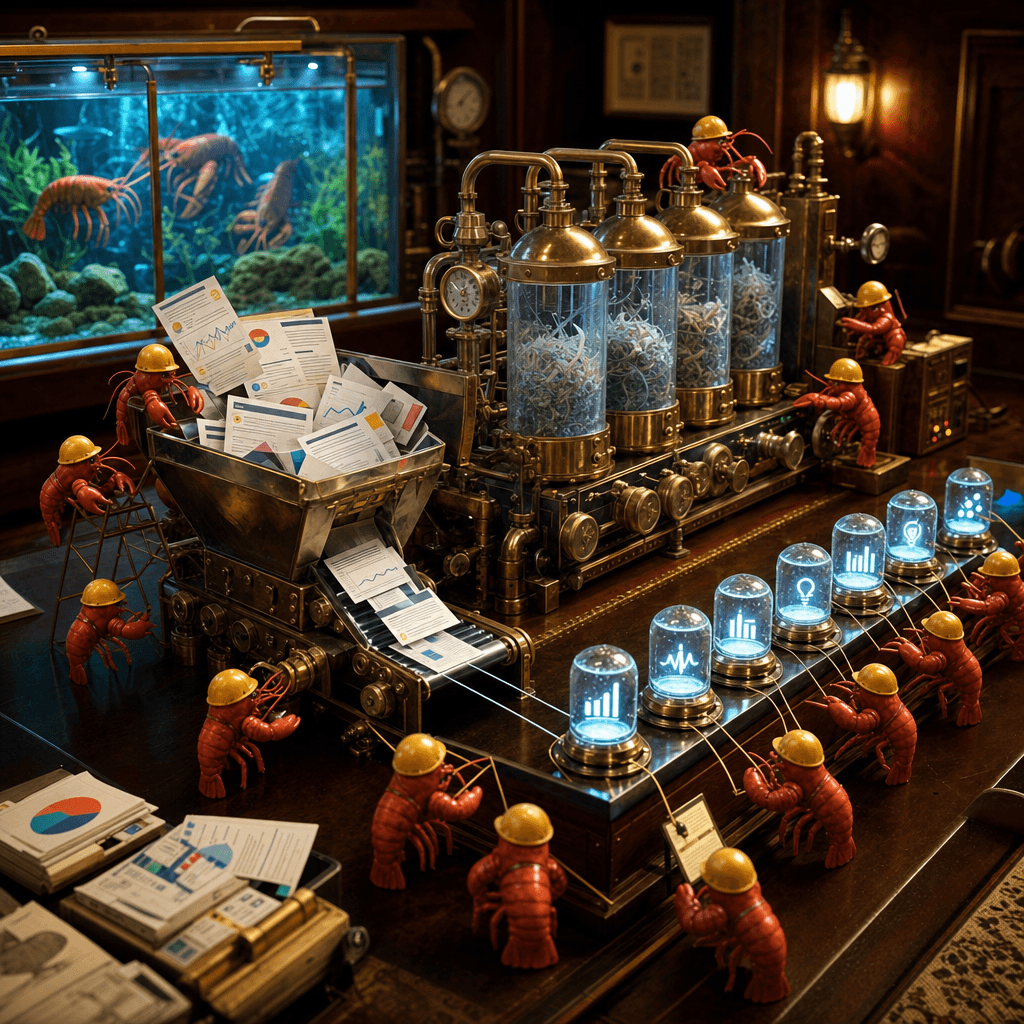
The pipeline runs continuously, not in batches. Each stage produces an artifact the next stage reads and an audit trail the reviewer can walk back through whenever a claim looks suspicious.
%% Pipeline, end to end
flowchart TB
  A["Source ingestion"] --> B["Normalization & enrichment"]
  B --> C["Signal extraction"]
  C --> D["Trend & friction clustering"]
  D --> E["Opportunity memos<br/>(Persona Claw)"]
  E --> F["Skeptic critique"]
  F --> G["Curation board<br/>(human gate)"]
  G --> H["Validation experiments"]
  H --> I["Scorecard"]
  I --> J["Prototype decision<br/>(human gate)"]
After ingestion, raw content gets cleaned, deduplicated, timestamped, and enriched with source type, source credibility, persona associations, entities, industries, geography, author, publication date, content hash. Boring; load-bearing. This is plumbing—a heartbeat-triggered normalization job on a fast-extraction model—not a Claw with memory or judgment.
The analysis engine extracts atomic signals—narrow enough to trace back to a source. Extraction types include behavioral shift ("real estate agents are using AI to draft listing copy"), market shift ("vendors are packaging AI features into existing professional software"), workflow shift ("teachers draft lesson materials with AI then adapt them"), friction ("dentists complain that insurance documentation creates repeated delays"), and workaround ("users export CSVs, paste into ChatGPT, copy outputs back"). Every signal stays linked to the source it came from—a Claw that produces a signal without a citation has its output rejected at write time.
Signals get clustered along behavioral, market, cultural, and workflow axes. Clusters produce trend candidates that retain links to underlying signals, so reviewers can inspect the evidence instead of trusting a summary. Clustering happens at multiple resolutions: small clusters for specific frictions, medium for persona-specific trends, larger for macro trends that may transfer across industries.
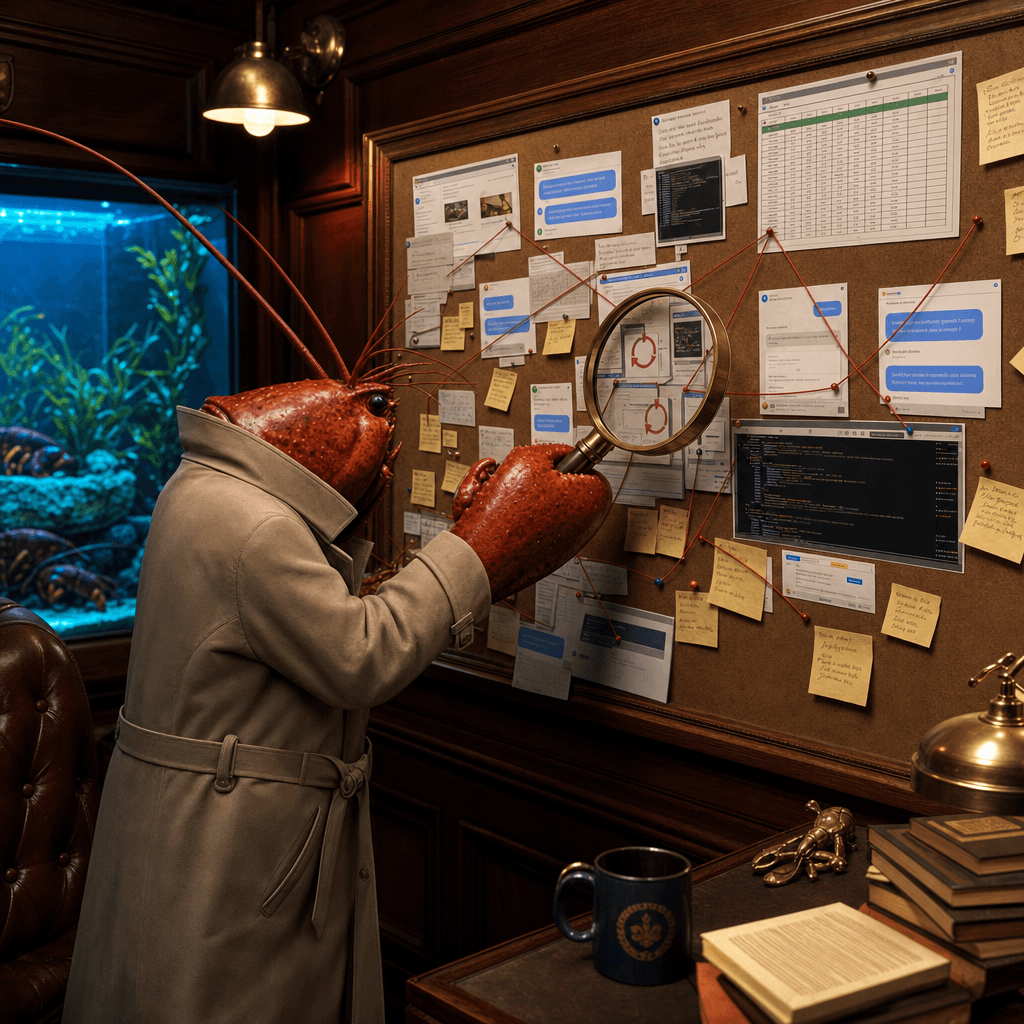
The system explicitly searches for workflow fractures: CSV exports, copy-paste behavior, screenshots used as APIs, spreadsheets used as databases, Slack threads used as process management, humans retyping between systems, repeated checking of AI output. Latent demand leaves footprints. These are where the existing tooling is broken and where someone is doing manual work that a real product could absorb.
Opportunity generation combines trend context, persona context, workflow friction, AI capability mapping, and pattern transfer. The goal isn't a long list of startup ideas—it's a smaller set of coherent opportunity theses with evidence, risks, and validation plans. Anyone with a model API key can generate a hundred ideas before lunch. The hard part is making each one defensible.
NOTE
Who writes the memo
The Persona Claw writes it—everything the memo needs (persona context, workflow friction, capability mapping, pattern bundles) is already in its hands. Output is status: drafted. The database rejects any memo whose evidence chain doesn't resolve back to underlying signals, and the Claw can't promote to validating—that's human-only.
Adversarial review
Every trend and opportunity faces an adversarial pass before it reaches the curation board. The reviewer's job is to disprove the thesis and find where the logic is weak. The questions:
- Is this already obvious? (Avoid restating mainstream consensus.)
- Is this just one viral anecdote? (Require repeated evidence.)
- Is this overfit to technology? (Avoid assuming technical users represent everyone.)
- Is this only true in one geography?
- Is this a rebrand of an older trend?
- Is there hard evidence of acceleration? (Distinguish growth from visibility.)
- Is the pain severe or merely annoying?
- Is the workaround cheap enough and good enough that the user will never switch? (The indifference filter—every workaround signal gets this question.)
- Why has this not already been solved?
- Can incumbents copy this quickly?
- Is there a viable distribution path?
If a thesis cannot survive that list, it does not reach the Curation Board.
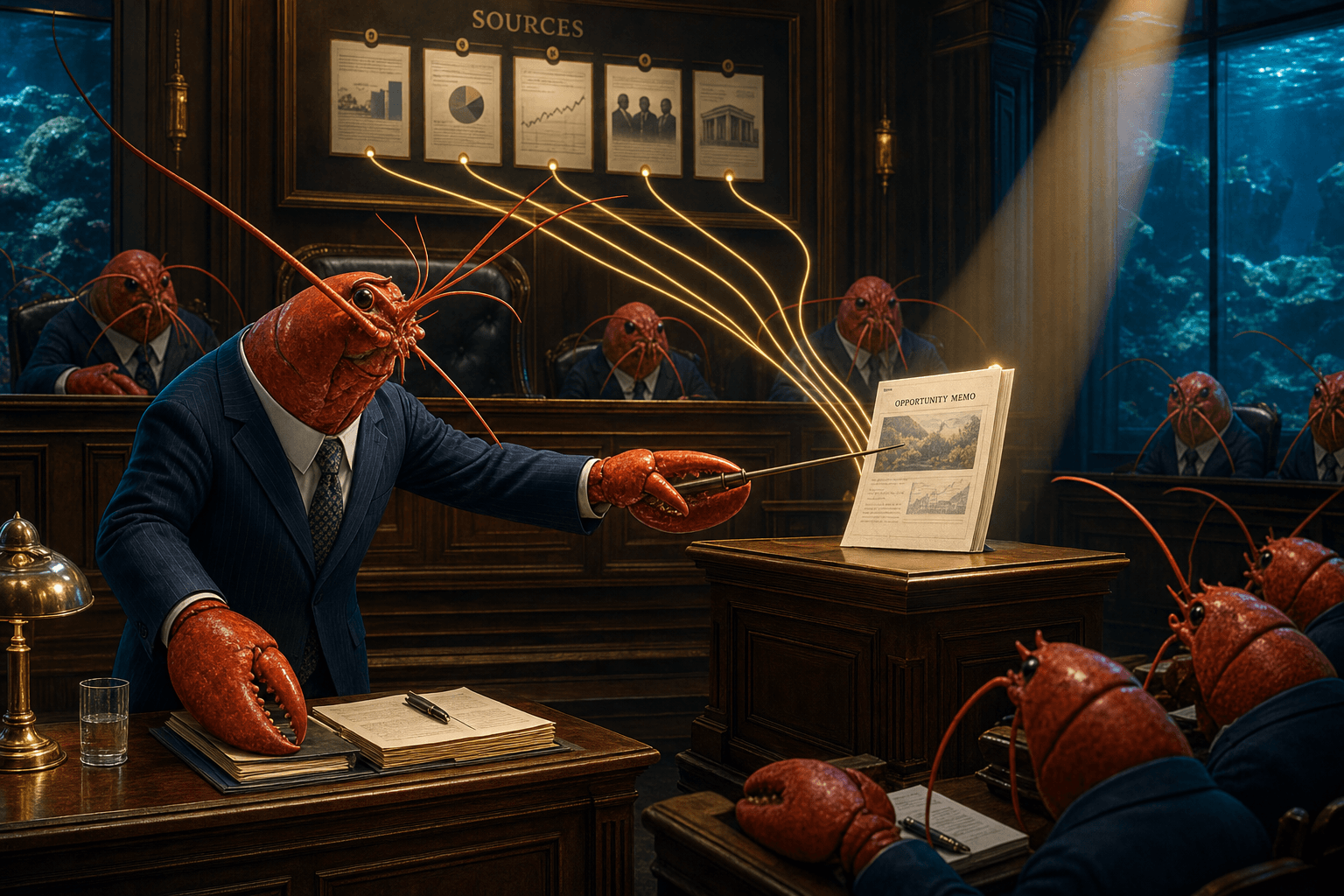
The indifference filter deserves a longer note. A workaround is sometimes a footprint of latent demand, sometimes a footprint of expressed indifference—the user has a free fix that is good enough and will not pay to replace it. CSV-pasting into a free LLM signals the user already found the answer, not that they are waiting for a paid version. Two cases worth keeping in the library: real demand—small-firm legal teams paying integration consultants quarterly to keep hand-curated multi-tool stacks talking; indifference—hobbyist users pasting documents into a free LLM for personal reading. Every adversarial review of a workaround signal should be able to cite which case applies.
NOTE
Why the Skeptic is structurally separate
Two guarantees make this work and both have to hold. First: the Skeptic runs on a different model family from whichever Claw produced the artifact—two Claws on the same model that share the same blind spots produce theatre, not critique. Second: the trigger is the database write, not the upstream Claw firing the Skeptic directly. The artifact lands in Postgres, the same transaction writes an outbox row, the Temporal CDC subscriber tails the replication slot and starts a fresh Skeptic workflow. The upstream Claw cannot decide whether its own draft gets reviewed. One finding per adversarial question, each with a confidence tag and a citation. Cannot promote, kill, merge, or rename.
The Curation Board
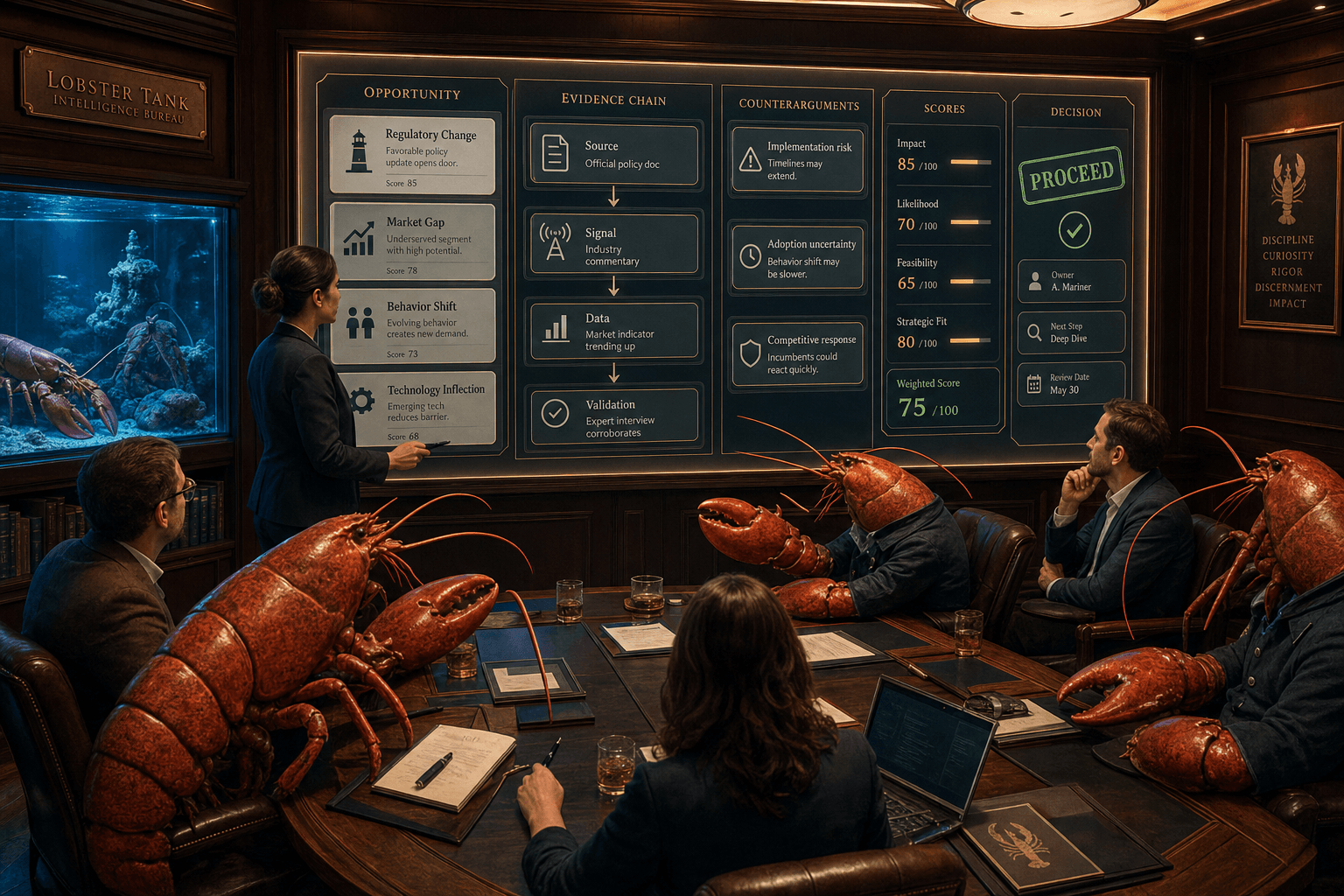
The Curation Board is where humans take over—and also where they can observe the process in the mean time. It shows AI-generated trend and opportunity candidates with evidence, scores, adversarial critiques, the due-diligence packet, adjacent patterns, and recommended next steps. Reviewers can merge, split, rename, reject, monitor, or promote.
Each item carries: opportunity name, one-sentence thesis, strongest signals, surprising examples, counterarguments, who benefits, who is threatened, what would make this false (falsification criteria), suggested adjacent trends, recommended action, plus the Mystic Note and Artist Note that we discussed above.
The Weekly Opportunity Review is where we walk the board: promote or reject candidates that have aged enough to decide on, identify which ones need more evidence. The output is a list of opportunities entering validation and a list of kills with reasons.
NOTE
No Claw owns the board
The Curation Board is a human review surface—status writes only come from a logged-in human. The inbox is pre-sorted by score and confidence (a SQL ORDER BY, not a Claw). When a human promotes a candidate, a prompt template drafts the Idea Validation experiment configuration (also a function call, not a Claw); the Idea Validation Claws pick up from there.
Stage gates
Most failures happen at the seams between stages, not inside any one stage. An experiment that should have stayed an experiment gets nudged into a concierge MVP; a concierge MVP that should have died gets nudged into a prototype. Every stage gate has the same shape: a small list of conditions, plus a human approver. If the conditions are not met, the project stays at its current stage or gets killed—those are the only two moves.
%% Stage gates
flowchart LR
  S["Signal"] -->|"gate"| O["Opportunity"]
  O -->|"gate"| V["Validation"]
  V -->|"gate"| C["Concierge MVP"]
  C -->|"gate"| P["Prototype"]
- Signal → Opportunity: evidence is repeated, not anecdotal. Persona clear. Workflow concrete. Friction named in the persona's own language.
- Opportunity → Validation: falsification criteria written down. Channel hypothesis testable. Right-to-build filter passed.
- Validation → Concierge MVP: qualified users have committed something costly. Pain severity documented in interview evidence, not just survey. Distribution access demonstrated at small scale. At least one outside read from a practitioner in the field on file.
- Concierge MVP → Prototype: repeated value delivery demonstrated. Ethics gate passed.
I own every gate decision. The Claws produce the evidence; humans approve or kill. Every promotion and every kill is logged with my name and a one-sentence rationale on the artifact.
The ethics gate
Before any prototype investment, the proposed venture passes a six-question yes/no gate. If I cannot answer all six with "yes," the project does not get prototype budget. This is not a scoring rubric. It is a yes/no.
%% Ethics gate
flowchart LR
  Q1["1. Agency"] -->|"yes"| Q2["2. Dignity"]
  Q2 -->|"yes"| Q3["3. Non-exploitative"]
  Q3 -->|"yes"| Q4["4. Trust"]
  Q4 -->|"yes"| Q5["5. Defensible model"]
  Q5 -->|"yes"| Q6["6. Sovereignty"]
  Q6 -->|"yes"| PASS["Prototype budget"]
  Q1 & Q2 & Q3 & Q4 & Q5 & Q6 -.->|"any no"| KILL["Kill"]
Each question carries anchor examples—yes, no, borderline—drawn from real ventures, so I am voting on the question rather than the room's mood.
- Does it expand user agency? Yes: a tool that gives independent contractors a clearer view of which projects are profitable so they can decline the unprofitable ones. No: a tool whose engagement depends on the user being unable to leave without losing accumulated work. Borderline tilts to no until the venture can show the user remains the author of the underlying decision.
- Does it reduce toil without degrading dignity? Yes: a claims-review copilot that handles documentation lookup and leaves the adjuster's judgment central. No: a customer-service tool that replaces the human's discretion with a script the human is now scored on adhering to.
- Does it avoid exploiting fear, status anxiety, loneliness, or professional insecurity? Yes: a peer learning platform whose engagement is driven by curiosity and reciprocity. No: a productivity tool whose growth loop is shaming the user for inactivity. Borderline tilts to no unless the discomfort is the user's own goal, not the product's growth lever.
- Does it create trust faster than it consumes trust? Yes: a financial tool that flags fees the user did not know they were paying, even when flagging costs me revenue. No: a service that depends on the user not reading the terms.
- Would I be proud to explain the business model publicly? Yes: clear pricing, clear data practices, a model I would describe identically to a customer, a regulator, and a journalist. No: any model I would describe differently to a customer than to an investor.
- Will users be more sovereign or more dependent in ten years? This is the Sovereignty Question—the one most likely to fail a venture the rest of the gate would have waved through. Yes: Stripe (developers ended up able to do more, on terms they could leave), Shopify (merchants ended up running businesses they own). No: any venture whose value compounds with the user's inability to operate without it.
Any single "no" fails the gate; the answer has to be six unanimous yeses, with a written rationale per question on the record. The ethics veto is live: anyone reviewing the work can invoke it at any stage, not just at the formal gate.
WARNING
The published failure log
Every quarter, the log of ventures that failed the gate that quarter goes public, naming the question that killed each one and the rationale. If no ventures failed in a quarter, that fact is itself published. Silence is a signal: either the gate is doing nothing, or the upstream pipeline is already filtering out the cases the gate exists to catch. I need to know which. The gate's authority comes from the artifacts it produces, not the conversation it describes.
A Monthly Design Review reads every venture currently in concierge MVP or prototype against a rubric covering visual craft, interaction quality, copy quality, and feeling-as-gift. I do the read myself, recorded against the rubric so it's auditable, not just vibes. Output: a written design read attached to the venture's evidence pack, carrying the same weight as the scorecard in the next stage-gate decision.
Idea Validation
This where things get interesting. The Claws have scoured the internet far and wide to surface the tastiest idea nuggets that they could possibly find. But, are we right? Are people actually interested in this? Are they willing to pay for this? Is this a plausible venture?
The way to answer those questions is simple (but, not necessarily easy): We give them the opportunity to sign up and pay. In my humble opinion, that's a pretty good way to tell.
Idea Validation is the part most opportunity-discovery efforts skip. Discovery produces memos. Memos are not businesses. A memo says "this looks interesting." A validation experiment says "here is what happened when I put this in front of the actual persona and asked them to commit something." The gap between those statements is where most startup ideas quietly die after burning a quarter of engineering time.
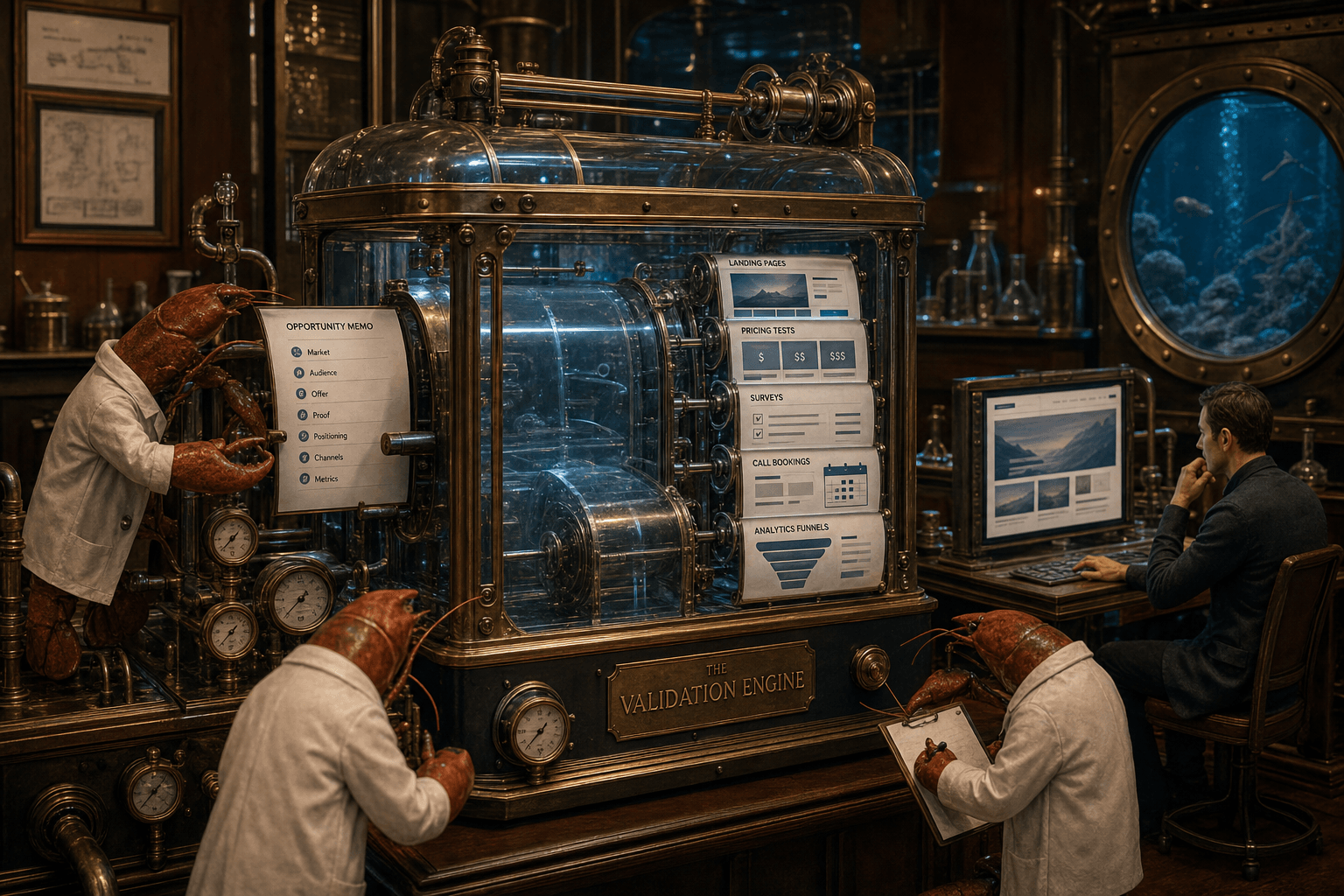
The validation engine is a repeatable experiment factory that converts selected candidates into instrumented market experiments—persona-specific landing pages, pricing tests, qualification surveys, ad variants, outbound campaigns, analytics funnels, decision dashboards. All generated from structured opportunity data, all measuring a standard set of signals so different opportunities can be compared fairly.
A compelling idea is not evidence of a business. A trend is not a buying signal. A pain point is not automatically a budget. The validation engine forces each candidate to survive contact with a real audience before engineering time is committed.
Decision ownership in Idea Validation. Validation budget, concierge MVP greenlight, prototype investment, experiment kill—all my calls. Prototype investment also requires the ethics gate to clear and at least one outside read from a practitioner in the persona's field. Every promotion and every kill is logged with my name and a one-sentence rationale on the artifact.
At a high level, this is the general shape (which is definitely up for debate and discussion):
- Take an opportunity that we vetted above
- Whip up a quick website with some product details, pricing information, and other requisite information.
- Add a sign-up form or—even better—the ability to book a call with us.
- Run some ads (Google, LinkedIn, Reddit, etc.) targeted at the persona in order to drive traffic to the site.
- Measure.
What we actually need to prove
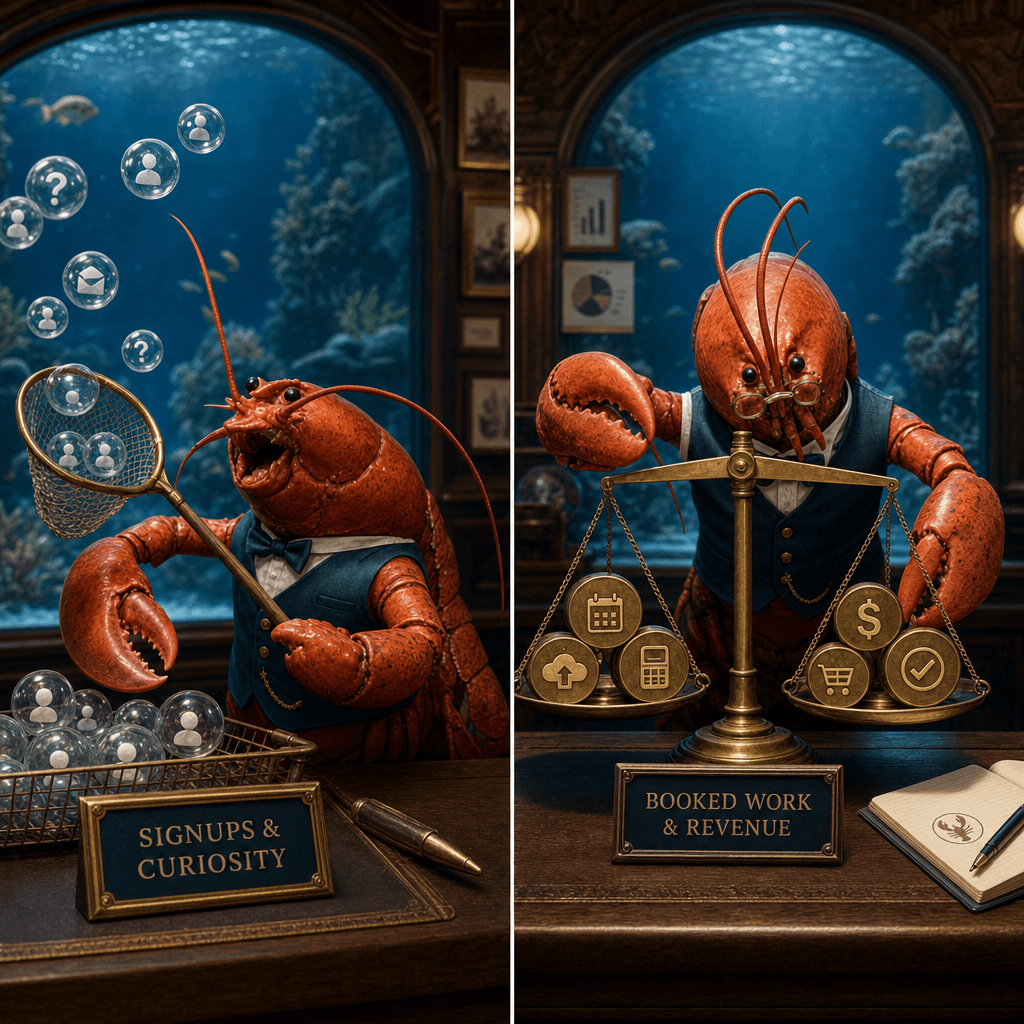
The central test is commitment, not interest. Lots of ideas are interesting. Seven dimensions, each with the evidence that answers it:
- Demand: does the message attract the right audience? Evidence: CTR, page engagement, CTA clicks, organic replies, community engagement.
- Persona fit: are the respondents the target users? Evidence: role, company type, seniority, work email, tool stack.
- Pain severity: frequent, costly, risky, revenue-linked? Evidence: survey answers, interviews, current workaround, stated consequence of inaction.
- Willingness to pay: does the persona see this as budget-worthy? Evidence: plan selection, checkout start, paid pilot interest, deposit.
- Distribution access: can we reach this audience economically? Evidence: CPC, cost per qualified lead, outbound reply rate, booked-call rate.
- Workflow reality: does the problem show up in real artifacts? Evidence: uploaded documents, spreadsheets, screenshots, transcripts.
- Prototype clarity: can we define a narrow product that delivers the promised outcome? Evidence: demo feedback, concierge delivery success, repeated requests.
TIP
Signal strength
A signup is a polite click. A booked call costs the visitor thirty minutes. A deposit costs them money. The system measures each separately. "We got 400 signups" sounds great in a Friday update and means almost nothing in a Monday strategy meeting. The metric that matters is the count of people who gave us something costly—time, money, information, or workflow access.
The validation pipeline
Eight stages, each feeding the next: select opportunity, define hypothesis, generate experiment configuration, publish validation assets, drive traffic and outreach, capture evidence, score and review, decide. The decide step is what this whole apparatus exists to feed.
NOTE
Three Claws, plus plumbing
Idea Validation runs end-to-end through OpenClaw with three professional Claws on top of webhook plumbing. The Web Developer Claw renders the landing pages, pricing variants, and surveys. The Marketer Claw prepares campaign briefs and UTM links. The Researcher Claw drafts interview scripts, codes transcripts, and runs the qualitative side. Webhook handlers normalize PostHog, Stripe, and Cal.com events into the operational database; a nightly aggregation produces the quantitative scorecard; the Skeptic Claw critiques the assembled packet before it reaches the Weekly Validation Review.
The Weekly Validation Review is where I read the scorecards and decision packets from live experiments and produce kill / revise / validate-more / concierge / prototype decisions—each with my name on it.
Landing page strategy
Every landing page is persona-specific and evidence-seeking. It doesn't read like the generic AI SaaS page—you know the one: purple gradient, "Supercharge Your Workflow" hero, a "Join Waitlist" button that tells you nothing about whether anybody wants the thing. I've personally shipped that page. Twice. The signal it produces is "people will click a button." The signal we need is "people will commit something costly." The page has to make a concrete promise, describe a recognizable workflow pain, show a plausible before-and-after, and ask for an action that reveals commitment.
Each page follows a standard skeleton. The hero states persona, pain, and promised outcome in one screen (signal: CTR-to-CTA alignment, bounce, scroll). Problem proof describes the pain in the persona's language (signal: scroll depth, time on page). Before-and-after workflow shows how the product changes the process. Use cases make the idea concrete through three to five specific tasks. Pricing reveals perceived category (signal: pricing-page view, tier selection, checkout start). Qualification survey captures role, company, tools, frequency, urgency, current workaround. Artifact upload asks for a real workflow input where appropriate—high-intent evidence and prototype material in one move. Book a call offers research, pilot, or design-partner conversations. FAQ handles common objections.
Each opportunity tests at least two positioning angles where the channel supports it. The five worth testing: time savings (high-frequency manual workflows), revenue capture (work that drives sales), risk reduction (regulated work), quality improvement (expert work where review matters), coordination reduction (multi-stakeholder workflows with handoffs).
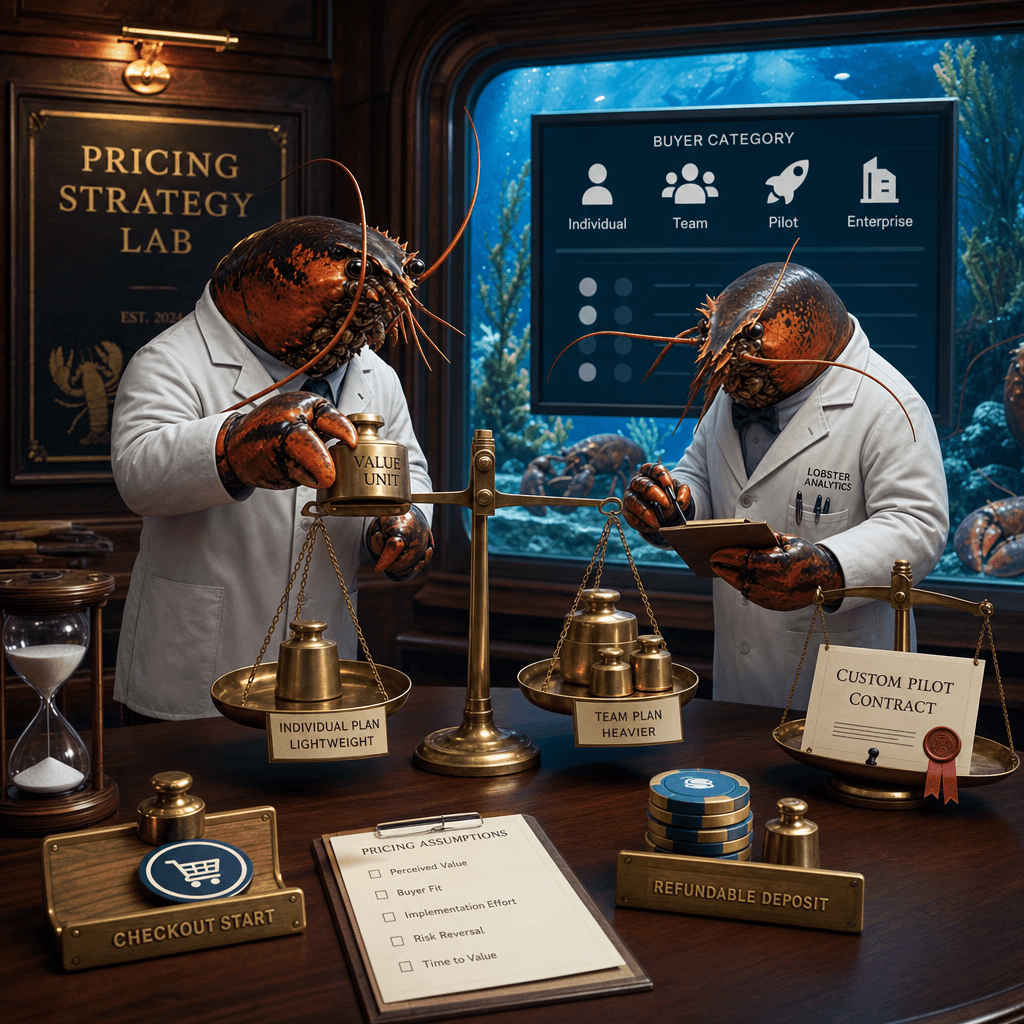
Pricing is part of the experiment, not deferred until after prototype. The number tells you what category the persona naturally puts you in. Five tests, weakest to strongest signal: $19–$49 individual (personal productivity?), $99–$299 team (pain extends beyond one user?), $499–$1,500 agency or business (linked to revenue?), custom pilot pricing (sales-led validation?), refundable deposit or paid pilot (does stated interest convert into economic commitment?). The refundable deposit is the demand test most teams flinch at—and the one that actually tells you something. If asking someone to put down $50 makes you uncomfortable, that's a sign you don't yet believe the demand is real.
Channels
Paid traffic is useful for message resonance and demand discovery, but it can validate clever ad copy rather than real product demand. The Marketer Claw prepares upload-ready campaign briefs and UTM-tagged links per channel and queues them for a human to publish—no Claw has API write access to a paid platform in the first wave. (To be 100% clear, it would be great if we got this Claw optimized to the point where we did fully trust it.)
The Marketer carries continuity from week to week: it remembers which channels flopped for which personas, which subject lines won the last outbound batch, and which audience definitions are running too hot. That memory is what separates it from a stateless template renderer.
Channels with their best-fit use: Google Ads for high-intent search where the persona already names the pain; Microsoft Ads for professional and older-skewing search at lower cost; Reddit Ads for community-based persona tests where weak creative backfires fast; LinkedIn Ads for B2B by title and seniority, expensive but precise; Meta and TikTok for consumer, prosumer, creator; newsletter sponsorships for niche professional audiences; outbound email for narrow B2B; communities and forums for persona-specific qualitative signal (carefully, without spam); Product Hunt and Hacker News for developer tools, a poor proxy for traditional industries.
Personas live in different places. Software engineers live on Hacker News, Reddit, GitHub, dev newsletters, X, Product Hunt. Professional services live on LinkedIn, Google Search, niche newsletters, industry communities, outbound, webinars. Local businesses live on Google Search, Meta, local groups, trade publications. Teachers and public-sector users live in interviews, communities, procurement research, district conversations—that row matters most and gets noticed last. You do not validate a teacher product with a LinkedIn ad. That conversation is six months long, not six days.
Qualitative validation
Analytics show what happened. They rarely explain why. For each opportunity that clears the demand threshold, run five to ten interviews focused on past behavior, not hypothetical enthusiasm—people are generous when asked "would you use this?" and accurate when asked "tell me about the last time this came up." Ask what triggered it, what tools and people were involved, what it cost in time and money, what they already pay for near this workflow, who would approve a purchase, what would block adoption, and—critically—what would make the product untrustworthy. That last question is the one most interviewers skip and the one that most often saves the prototype from foreseeable failure.
Before building a full product, manually deliver the promised outcome for a small number of qualified users. If the manual version does not create value, automation will not rescue the idea. Four qualitative methods carry different jobs: concierge MVP (does the user value the outcome enough to repeat or pay?), clickable mockup (is the workflow understandable?), artifact-based test (will users share real workflow inputs?), pilot application (operational need and implementation readiness?).
NOTE
A researcher with continuity
The Researcher Claw drafts interview scripts, codes transcripts, ingests concierge session notes, runs the Six-Month Dignity Check, and produces structured ratings for the scorecard. It doesn't replace human interviews—it summarizes and codes them so qualitative reads compare cleanly across experiments. And like any decent researcher, it remembers what each persona keeps saying across calls, even when nobody named it out loud.
The technical stack
This is discussed further in the Architecture section.
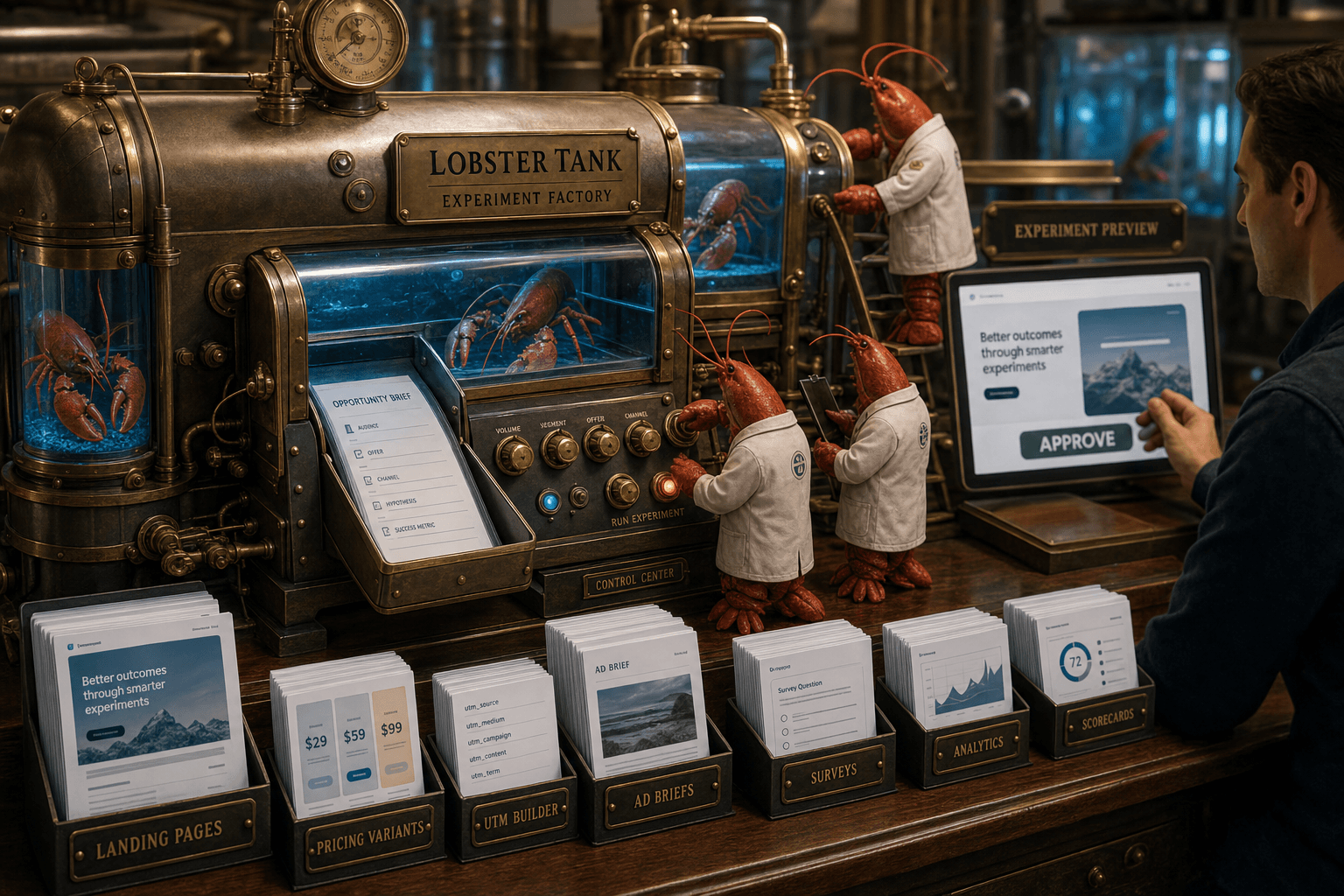
The validation engine is a reusable experiment factory, not a collection of one-off landing pages. A new opportunity is defined as structured config, then used to generate pages, tracking, forms, pricing variants, ad briefs, UTM links, and dashboards.
Baseline stack: SvelteKit on Vercel for experiment pages, Neon Postgres for the data plane (same database the Idea Farming pipeline uses—no separate validation stack), PostHog for product analytics and feature flags, GTM + GA4 for ad tracking, Stripe for pricing tests and deposits, Resend for transactional email, Cal.com for booking, Attio for the relationship-aware CRM, Cloudflare Turnstile on every CTA so the "qualified signups" number isn't half scrapers, and the Google Ads API introduced only after manual launch stabilizes. Full stack rationale in Architecture.
Each experiment is defined by a structured ValidationExperiment config. Hypothesis and success criteria are required; the experiment cannot launch without them.
type ValidationExperimentConfig = {
  id: string;
  opportunity_id: string;
  persona_id: string;
  hypothesis: string; // required, what must be true
  positioning: {
    headline: string;
    subheadline: string;
    pain_statement: string;
    promised_outcome: string;
    before_state: string;
    after_state: string;
  };
  pricing: {
    model: 'individual' | 'team' | 'agency' | 'pilot' | 'deposit';
    tiers: {
      name: string;
      price_usd: number;
      interval?: 'monthly' | 'annual' | 'one_time';
    }[];
  };
  ctas: {
    primary:
      | 'book_call'
      | 'signup'
      | 'deposit'
      | 'pilot_application'
      | 'artifact_upload';
    secondary?: 'survey' | 'newsletter';
  };
  channels: ChannelPlan[];
  success_criteria: ExperimentThresholds; // required, set BEFORE launch
};
The data model preserves relationships between opportunity, persona, experiment, variant, channel, visitor, and event:
%% Experiment Data Model
flowchart LR
  Opportunity --> Experiment
  Persona --> Experiment
  Experiment --> LandingPageVariant
  Experiment --> PricingVariant
  Experiment --> ChannelPlan
  ChannelPlan --> AdVariant
  Experiment --> Visitor
  Visitor --> Event
  Visitor --> Signup
  Signup --> SurveyResponse
  Signup --> ArtifactUpload
  Signup --> CallBooking
  Signup --> CheckoutSession
  Experiment --> ExperimentScore
The standard event taxonomy is named identically across every experiment so cross-experiment comparison is possible without rewriting analytics: page_view, scroll_50/scroll_90, hero_cta_click, pricing_view, pricing_tier_selected, signup_started/signup_completed, survey_started/survey_completed, artifact_upload_started/artifact_upload_completed, book_call_clicked, checkout_started/checkout_completed, faq_expanded. Every event carries the same property bag: experiment_id, opportunity_id, persona_id, variant_id, UTM fields, plus the qualifying fields role, company_size, selected_tier, declared_budget, urgency.
Scoring
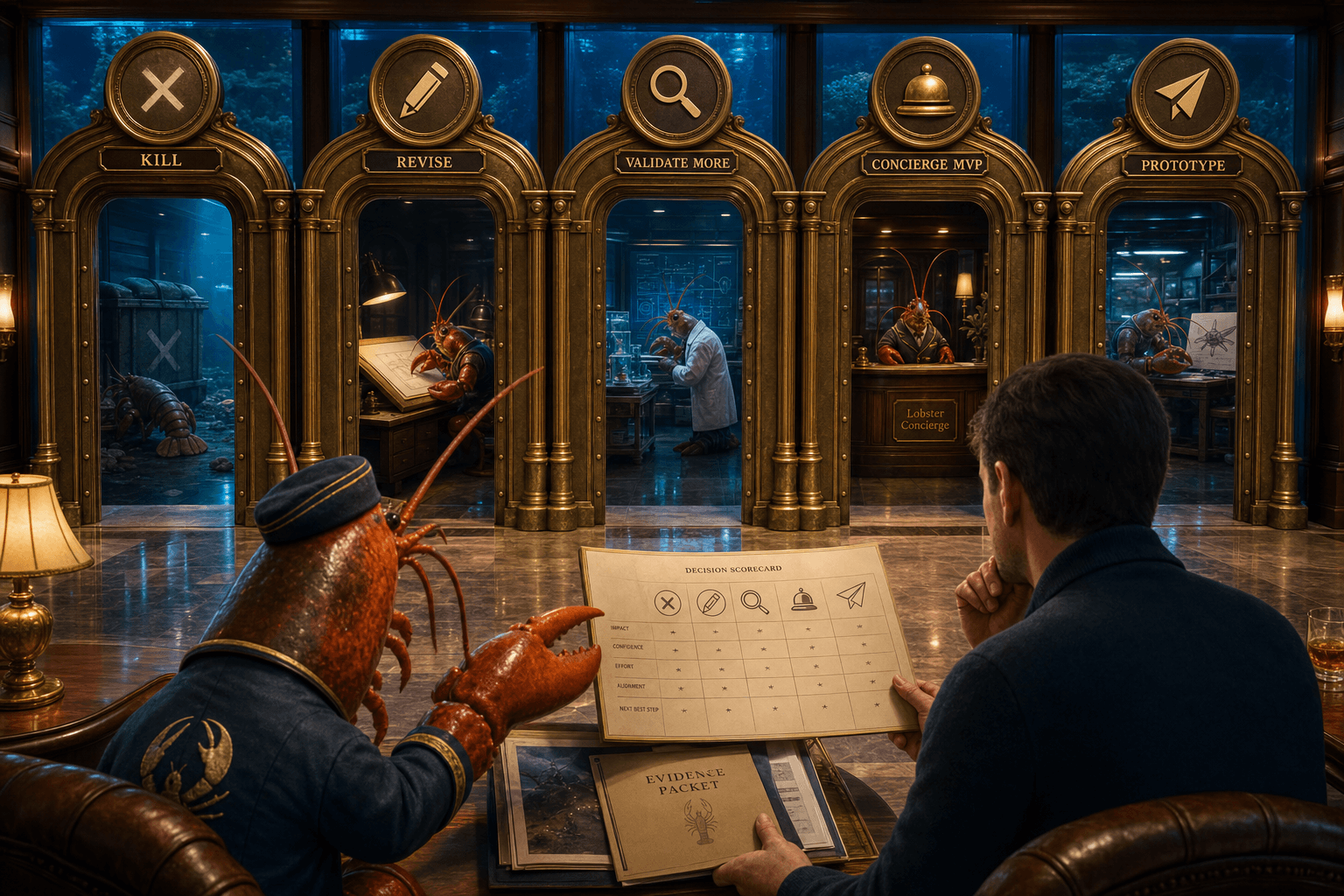
NOTE
Three artifacts, one decision packet
Scoring runs nightly during an active experiment (on-demand on request). The quantitative half is a SQL aggregation—not a Claw. The Researcher Claw produces the qualitative ratings. The Skeptic Claw critiques the assembled scorecard, watching for cases where a single channel, a single high-intent visitor, or a clever positioning angle is doing all the work. All three land on the reviewer's decision packet. The decision column is null until a human writes it.
WARNING
Who scores, and who does not
The person who designed and ran a validation experiment cannot also be the one who scores it. The same person who built the demo does not grade the demo. Qualitative interviews with concierge users are conducted by someone without skin in the opportunity. Where team size makes strict separation impossible, the scoring partner is the one whose calendar shows the least time spent on the opportunity that quarter.
Seven dimensions:
- Persona fit (20%)—qualified signup rate, role match, buyer/user clarity, work email rate.
- Pain severity (20%)—frequency, urgency, current workaround, cost of inaction, interview evidence.
- Paid intent (15%)—plan selection, budget range, checkout start, deposit, paid pilot interest.
- Six-month dignity (15%)—structured 20-minute follow-up calls with three of the original five concierge MVP users at month six. Plain-language question: did the product make your work better in a way you would defend to your kid? Binary signal per user; the score is the rate of clear affirmatives.
- Channel access (15%)—CPC, cost per qualified lead, outbound reply rate, booked-call rate, community access.
- Message resonance (10%)—CTR, bounce rate, scroll depth, CTA clicks.
- Prototype confidence (5%)—concierge feasibility, artifact quality, narrow MVP clarity, repeated requests.
const validationScore =
  personaFit * 0.2 +
  painSeverity * 0.2 +
  paidIntent * 0.15 +
  sixMonthDignity * 0.15 +
  channelAccess * 0.15 +
  messageResonance * 0.1 +
  prototypeConfidence * 0.05;
Persona fit, pain severity, paid intent, and six-month dignity together carry 70%—intentional. The first three are where teams most often deceive themselves at the funnel; the fourth is where they deceive themselves about the longer arc. A funnel will book a call for a predatory product and a humane one with equal enthusiasm—six-month dignity is the dimension that distinguishes them. The dignity check is lagged (data does not exist until month six), so until then the dimension scores as pending and lower-/upper-bound scores both surface on the decision packet. Once data arrives, the dimension is binding.
The decision-gate logic:
%% Decision Gate Thresholds
flowchart TD
  A["Experiment scorecard"] --> B{"Target persona qualified?"}
  B -- "No" --> C["Kill or revise persona"]
  B -- "Yes" --> D{"Pain recent and costly?"}
  D -- "No" --> E["Revise positioning"]
  D -- "Yes" --> F{"Paid intent present?"}
  F -- "No" --> G["Validate more"]
  F -- "Yes" --> H{"Workflow still uncertain?"}
  H -- "Yes" --> I["Concierge MVP"]
  H -- "No" --> J["Prototype"]
Five possible outcomes per experiment: kill (weak persona fit, weak pain, no paid intent, poor channel access), revise (audience engages but persona, copy, pricing, or promise looks wrong—change one and retest), validate more (signals promising but ambiguous), concierge MVP (pain and access are real but workflow is uncertain—manually deliver the outcome before building), prototype (strong qualified demand, clear pain, credible paid intent, narrow MVP scope). Kill and Revise should be the most common outcomes. If we are not killing or revising the majority of what we test, the bar is too low.
Thresholds get calibrated by persona, price point, and channel. Still, every experiment defines minimum success criteria before launch, because post-hoc rationalization is the single most common failure mode in validation work.
Validation MVP scope
Must have on day one: config-driven landing pages, the experiment/persona/variant/channel data model, the standard event taxonomy, signup/survey/pricing-tier/call-booking capture, manual ad briefs and UTM generation, the scorecard and decision-gate workflow.
Should have later: automated copy generation from opportunity records, dashboard templates, PostHog feature flags and A/B variants, Stripe deposit and paid-pilot flows, artifact upload and review workflow, concierge MVP workflow templates.
Not in the first version: full ad-platform campaign automation, custom attribution modeling, complex ML-based opportunity scoring, full CRM replacement, automated lead enrichment, general-purpose marketing CMS. The third column is the one to defend—most validation projects fail because they accidentally build it on day one, then run out of energy before doing the first column properly.
The first production use tests a small portfolio, not a single opportunity. Three to five opportunities, spread across at least one technical persona, one professional-services persona, and one non-technical SMB or operator persona, run across at least one search-intent test, one community/persona test, and one outbound test. Weekly evidence review. The primary output is ranked prototype recommendations supported by evidence, not subjective enthusiasm—replacing the meeting where the loudest person picks the next prototype with a scorecard anybody can read.
Every experiment starts from the same brief. The fields look simple, but each one forces a decision that prevents post-hoc rationalization later: opportunity name, persona, hypothesis, pain statement, promised outcome, current workaround, pricing assumption, channel assumption, primary CTA, success criteria, and risks. The risks row is the one most teams want to skip and the one that most often saves a quarter—naming the false-positive risks up front means a clever ad headline does not get to masquerade as product-market fit.
Reflection and Improvement
The point of Reflection and Improvement is the system gets smarter. Most pipelines learn implicitly—in hallway conversations, in collective memory, in patterns that get noticed but never written down. I'm betting that explicit learning compounds and implicit learning evaporates the moment anyone joining the project has to pick it up cold.
What gets learned
- About personas: which personas actually engaged when we tested them, which channels worked, which price points landed, which workflow frictions were as real as we thought, and which were us projecting. Persona profiles update from each validation cycle with the evidence attached.
- About patterns: which pattern methods produced opportunities that survived validation, which died at the curation board, which should never have been written. Each pattern carries its own track record. Some retire. Some get refined. New ones get added when reality demands them.
- About scoring: which dimensions correlated with validation outcomes, which did not. The opportunity score and the validation scorecard both get recalibrated quarterly against actual outcomes.
- About the thesis itself: where our taste was right, where it was wrong, where we were tourists, where we had genuine right-to-build.
NOTE
Quarterly output
The Reflection Claw runs once a quarter. It reads every postmortem from the cycle, joins each back to its original memo and scorecard and critique, recomputes each Pattern Library bundle's track record, and tests proposed scoring-weight changes against actual outcomes from the last two quarters. Output: a single recalibration packet with pattern retirements, weight changes, persona-mix observations, and an answer to "what did we believe last quarter that we believe less now?" Nothing writes to live rubrics—every change is human-approved at the Quarterly Thesis Review.
Rituals that keep the system honest
A small number of recurring meetings, each with a definite output. If a ritual is not producing a decision or a learning, it gets killed.
- Monthly Kill Meeting: I review every project not yet killed and ask why not. The default question is "what would have to be true to stop this?" Output: explicit kill calls or written defenses.
- Quarterly Cross-Silo Provocation: paid 90-minute session with 4–6 external voices from a standing rotation—artist, regulator, grassroots organizer, public-sector practitioner, frontline domain expert. Their dissent is logged with names. The roster is published and refreshed annually. If a quarter passes where every provocateur agrees with me on everything, the roster gets refreshed: agreement at that volume means the room got narrow.
- Quarterly Thesis Review: re-examine the strategic thesis in light of evidence. Output: a revised, dated, signed thesis document. Reads the postmortems, the formed-venture snapshots, the killed-experiment reports, and asks:
- Which parts of the thesis were vindicated this quarter? Which were contradicted?
- Are we still inside our declared scope, or have we drifted? Was the drift productive (the world shifted under us) or accidental (we lost discipline)?
- Are the patterns we are using the right ones for the kind of company we want to form? Or are the SaaS-shaped patterns dominating because they are the easiest to score?
- Is the persona mix still the right one? Are we ingesting the right sources?
- What is one thing we believed at the start of the quarter that we believe less now?
- Postmortems: mandatory for every kill at every stage, plus every formed venture at the six-month mark. Output: postmortem linked to the candidate's record so the system remembers.
The history of revised thesis documents is a stack. Anyone joining can read backwards and understand how the thinking has changed and why.
One countervailing ritual sits alongside the throughput cadence:
- The Slow Track: each year, exactly one opportunity goes on a 12–24 month hold. No experiments. No scorecard. A monthly partner meditation note attaches to the opportunity record. The point is to let one thesis ripen at a pace the rest of the metabolism doesn't allow. "Slow" doesn't mean "unaccountable"—if no new external evidence accumulates in six months (no closure, no regulatory shift, no candidate appearing), the opportunity exits and either re-enters normal flow or gets killed.
Kill discipline
Killing an experiment is easy. Killing a beloved thesis, a politically attractive idea, a project I'm emotionally invested in, or a venture that is technically alive but not actually winning—that is hard. Four rules:
- Defend, do not default. The monthly kill meeting asks "why is this still alive?" for every active project. The default is not "keep going." The default is "make the case." If the case cannot be made out loud, the project ends.
- Sunk cost is not evidence. The amount of money or time spent so far is irrelevant to whether to continue. The only question that matters: what would have to be true for this to work from here, and is that true?
- Beloved kills get postmortems too. Especially beloved kills. Same rigor as a kill on a project nobody loved. What did I want to be true? What was actually true? What signal did I miss? What signal did I explain away?
- Use the Skeptic Claw as the standing loyal opposition. At every kill meeting, the Skeptic produces a fresh adversarial read on every active project—running on a different model family from whichever Claws were involved in producing the artifacts under review. The Skeptic is not the decision-maker; the case still has to land on me. But the Skeptic argues for ending every project on the calendar by default, so I never have to remember to be the cynic.
The AI capability stack
The pipeline runs on AI capability the way an early SaaS company runs on AWS. Cost, reliability, failure modes, and vendor relationships are load-bearing assumptions—"synthesis-grade model" and "fast-extraction model" need specificity, or the first vendor email is a crisis.
Model tiers: a fast-extraction tier (small, low-cost model for atomic operations—signal extraction, entity tagging, deduplication; cost target: cents per thousand operations; at least two providers maintained at all times); a synthesis-grade tier (larger model for opportunity drafting, adversarial review, qualitative coding, scorecard reading; cost target: low single-digit dollars per memo; primary + documented backup, orchestrator routes between them); a long-context tier (cross-document reasoning across a persona's corpus or a venture's full evidence pack; tens of dollars per heavy pass, used sparingly; whichever model offers the strongest large-context reasoning, evaluated quarterly). Acceptable failure modes are bounded in all three tiers—Claw output never writes a promoted record without human review.
Capability assumptions: synthesis-grade models produce memos whose evidence chains resolve to real signals at least 90% of the time (the Skeptic Claw and the curation board catch the rest); fast-extraction models tag signal types and personas with enough precision that the curation queue is usefully prioritized; model providers continue to offer commercial access on terms compatible with the operating budget.
Contingency commitments: at a 4× cost increase from any single provider, the LiteLLM proxy routes around it within one operating week—the architecture is multi-provider by design (see LLM proxy and routing), and the cost discipline of being able to switch is exercised every quarter even when no switch is required. At a capability regression (a model getting worse), the affected Claw tier degrades to the next-strongest available model in the same tier and more candidates land on the curation board with "needs human extension" tags—the pipeline slows, it does not break. At a capability jump (a new model class enabling work that wasn't possible before), the Quarterly Thesis Review is where new capability enters the model—no single capable model gets to rewrite the operating plan in a hallway conversation.
We are not forecasting which way the model market goes. We are committing not to be quietly broken by movement in any direction.
Architecture, product, measurement
Architecture
Modular and observable. The asset we're actually building is the graph—personas, signals, opportunities, evidence, decisions, and how they connect. Every Claw, every dashboard, every UI is a surface over that graph. Swap any of them out and the asset survives. Lose the graph and we have nothing.
%% Architecture Component Diagram
flowchart TB
  A["Source connectors"] --> B["Scheduler and queue"]
  B --> C["Raw content store"]
  C --> D["Operational database"]
  D --> E["Vector index"]
  D --> F["Graph layer"]
  E --> G["OpenClaw orchestration"]
  F --> G
  G --> H["Evaluation harness"]
  G --> I["Curation app"]
  I --> J["Validation loop"]
  J --> D
  K["Observability"] --- B
  K --- G
  K --- J
The headline components: source connectors and a raw content store; an operational database holding the personas, signals, trends, opportunities, and the relationships between them; a vector index for semantic search and deduplication; OpenClaw orchestrating the Claws on top of all that; an evaluation harness measuring extraction quality and hallucination risk; the curation app where humans decide; the validation loop capturing interview notes, scorecards, and postmortems.
The pilot stack is small, hosted, and built from things easy to leave. Neon Postgres (with pgvector and a relationships table) for the operational database. Cloudflare R2 for object storage. Temporal Cloud for durable workflows and for the change-data-capture subscriber that wires database writes into the Skeptic Claw. MotherDuck for the analytical layer the Reflection Claw reads against. LiteLLM as the provider-abstracted LLM proxy that makes the "4× cost spike, route around it in a week" commitment actually enforceable. Langfuse for LLM observability on top of OpenTelemetry. SvelteKit on Vercel for the web surface. Clerk for identity. Doppler for secrets. One database for the whole pipeline—Idea Farming and Idea Validation share Neon, because phases of the work shouldn't mean phases of the infrastructure.
I'm picking hosted versions because I'm not in the infrastructure business—I'm in the better-decisions business. Every hour spent patching a Temporal worker is an hour not spent on the pipeline. The infrastructure cost on day one is a few hundred dollars a month across the whole stack; the cost of self-hosting any of it is at least a quarter spent on operations. Each named tool is either vanilla open infrastructure (Postgres, S3-compatible storage, a Temporal cluster) or a thin convenience layer in front of it—the lock-in story matters more than the dashboard convenience, and every vendor on the list above has a documented swap-in in Architecture.
Six rules keep it from drifting into a mess: Postgres as the default source of truth until proven insufficient; every AI-generated claim linked to evidence; prompts, scoring rubrics, Pattern Library bundles, and extraction schemas treated as versioned assets in git; every Claw run reviewable and reversible because state lives in Postgres (see memory model); optimize for human decision quality, not autonomous volume; design the graph so new primitives can be added without destructive migrations.
The full deep dive—every named tool with its alternatives, the LLM tier assignments, the dedupe strategy, retention policies, RBAC posture, CI/CD pipeline, the cost model, and the "what I am not building" list—lives in Architecture.
Product
The product should feel like an intelligence workbench, not a chatbot. If the user opens the app and sees a text box that says "Ask me anything," we have failed.
The primary surfaces:
- Source Manager: configure sources, schedules, persona associations, trust scores, ingestion status.
- Persona Dashboard: market profile, AI readiness, communities, influencers, software stack, trends, frictions, opportunities for the persona.
- Trend Map: explore broad and persona-specific trends, supporting signals, acceleration, adjacent trends, counterexamples.
- Opportunity Board: ranked opportunities by score, persona, workflow, pattern, confidence, prototype readiness.
- Pattern Library: browse, edit, score, and apply reusable patterns.
- Curation Board: the human review inbox for Claw-generated candidates.
- Evidence Browser: inspect raw source excerpts, summaries, confidence scores, provenance.
- Validation Console: experiment configs, live scorecards, decision packets, qualitative interview notes.
Measurement

We're optimizing for better prototype candidates, not more ideas. If anyone ever puts "ideas produced per week" on a dashboard, we've wandered into the wrong meeting—politely excuse ourselves and go back to the right one.
TIP
North star
Validated prototype candidates per month—opportunity hypotheses that pass curation, have credible evidence, receive a concrete validation plan, and produce useful market or prototype learning.
Three patience metrics sit alongside throughput, to prevent the throughput metric from becoming the only metric:
- Opportunities held longer than twelve months. Slow accumulators matter.
- Ventures formed from the Slow Track. The yearly opportunity that ripened.
- Ventures refused despite signal, because timing or founder fit wasn't yet right. The discipline of not forming.
Supporting metrics by category:
- Source coverage: active sources, freshness, ingestion reliability, persona coverage, duplicate rate.
- Signal quality: reviewer acceptance rate, evidence grounding, extraction precision, unsupported claim rate.
- Trend quality: curation promotion rate, evidence breadth, acceleration accuracy, cross-persona transfer success.
- Opportunity quality: memo acceptance, prototype promotion rate, validation success, false-positive rate.
- Pattern performance: hypotheses per pattern, reviewer acceptance, validation outcomes by pattern.
- Decision velocity: time from ingestion to reviewed memo, memo to validation plan, validation to decision.
- Business impact: prototypes shipped, paid pilots, decisions influenced, ideas killed before wasting build time.
- System health: cost per signal, cost per memo, job latency, model error rate, reviewer workload.
Evaluation combines automated tests, labeled review sets, and human judgment:
- Golden examples for signals, frictions, trends, opportunities, and adversarial critiques run as Promptfoo evaluations in CI.
- Review outcomes are tracked so the system learns which sources and prompts produce useful candidates.
- Hallucination is measured by requiring evidence links for every material assertion—a memo whose claims don't resolve back to underlying signals is rejected at the database layer.
- Claw-generated opportunities are compared against human-generated opportunities during the pilot.
- Postmortems on rejected and failed opportunities feed back into scoring at the Quarterly Thesis Review.
Risks
The main risks here are not technical impossibility—infrastructure is approachable, models are good enough, data is reachable. The risks are bad epistemology on the discovery side (confident nonsense from the model) and seductive signals on the validation side (data that looks like demand and is not).
Idea farming risks and their mitigations:
- Hallucinated claims → require evidence links + Skeptic adversarial review on every memo.
- Source bias → track source type, geography, credibility, and overrepresentation per persona.
- Overfitting to tech communities → separate general from persona-linked sources; include lower-AI-readiness personas (teachers and dentists in the initial set partly for this).
- Idea volume over quality → optimize for validated candidates, not total generated.
- Obvious or crowded ideas → use non-obviousness, competition density, and incumbent analysis in scoring.
- Weak distribution → require a distribution strategy field before promotion. No distribution thesis, no promotion.
- Privacy or ToS issues → approved sources only, respect policies, avoid sensitive personal data.
- LLM cost growth → staged processing, caching at the LiteLLM proxy, smaller models for extraction, cost-per-Claw dashboards (see Architecture).
- Reviewer bottleneck → prioritize curation queues by score and confidence; batch review.
Validation risks and their mitigations:
- False positives from curiosity → measure stronger signals (plan selection, booked calls, deposits, pilot applications).
- Misleading persona traffic → require qualification fields; segment all metrics by role and source.
- Ad copy validating copy rather than product → pair analytics with interviews and concierge tests.
- Sample too small → use experiments as gates for more validation, not as final proof.
- Over-automation too early → start with generated assets and manual launch; automate only what repeats.
- Sensitive artifact handling → limit upload types, add consent language, redact PII at ingestion, define retention (see Architecture).
- Channel economics distortion → evaluate CAC relative to expected ACV; use multiple channel types.
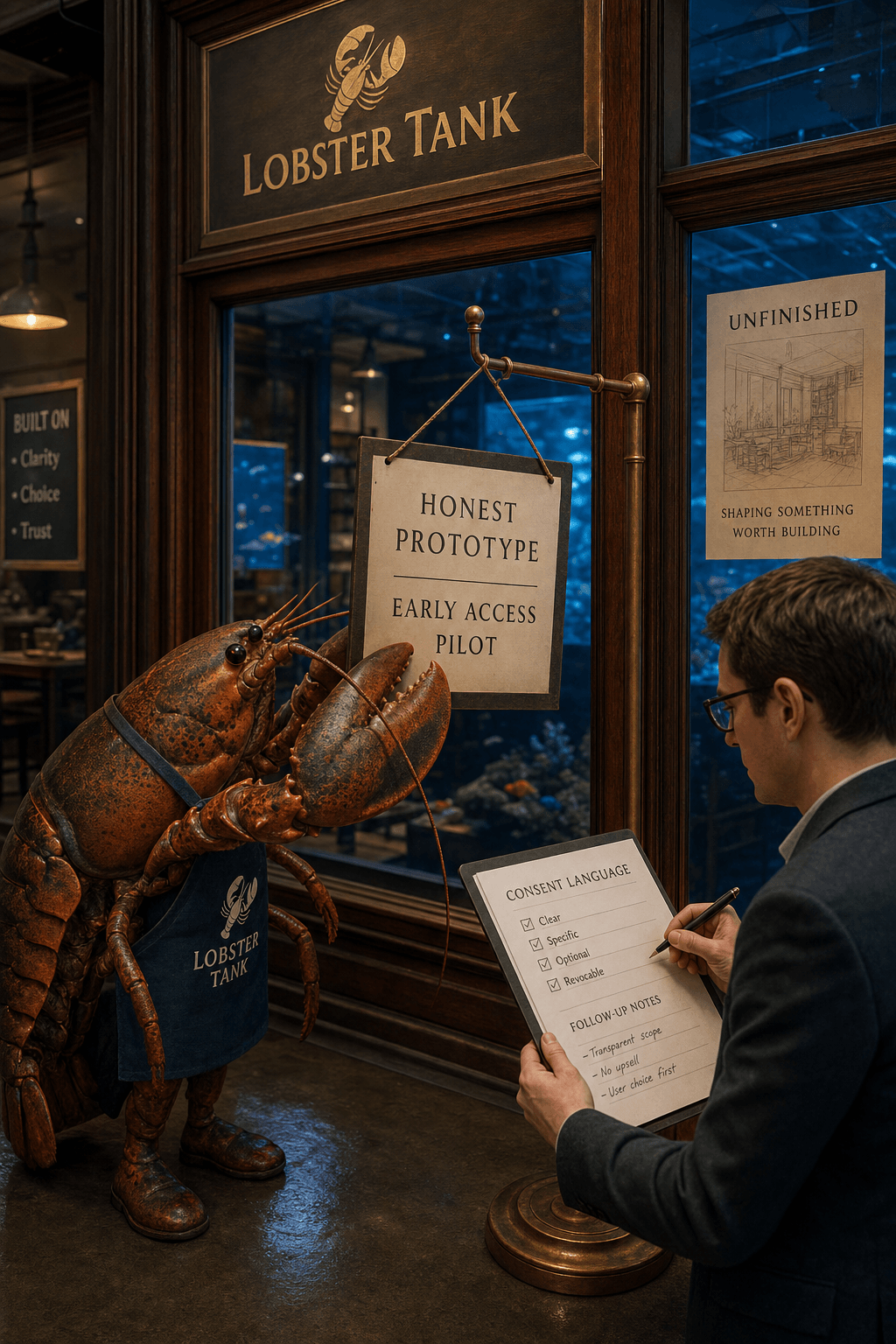
Fake-door ethics deserves its own paragraph. Pretending a product exists damages trust. Use clear labels (early access, pilot, prototype, design-partner program) and follow up even when the experiment was killed—the mitigation is not optional. If a real-estate agent fills out a survey expecting access to a tool that doesn't exist and never gets a follow-up, that agent thinks less of me. The Idea Validation ethics gate covers business-model harms; this one covers experiment-design harms.
Build sequencing
Build the pipeline by hand for one quarter before automating anything. Standardize the artifacts—memos, scorecards, decision packets, postmortems—and the cadence of every ritual. Then, and only then, build the system parts of this document, in the order the manual process screams loudest, not the order the architecture diagram says.
Build the Idea Farming Claw stack (Persona Claws, the Scout Claw, the Market Analyst Claw, and the Skeptic Claw, sitting on top of the ingestion connectors and extraction plumbing) before the Idea Validation experiment factory. The most common failure mode is building the experiment factory before proving the discovery loop produces opportunities worth validating; the second most common is skipping the manual-standardization step and jumping straight from Idea Farming to automation. Automation that codifies a vague process produces vague automation.
Initial persona set
Mixed to stress-test transfer across AI readiness levels, software maturity, workflow digitization, and willingness to pay: software engineers (high AI readiness, fast feedback loops); real estate agents (revenue-driven, lead generation pressure, fragmented tooling); lawyers (high-value document workflows, strong willingness to pay, high constraints); dentists (operational complexity, insurance pain, lower AI saturation, local-business dynamics); public school teachers (high workflow burden, lower monetization clarity, policy constraints). Software engineers are easy mode. Public school teachers are hard mode. If a pattern transfers across that range, it transfers.